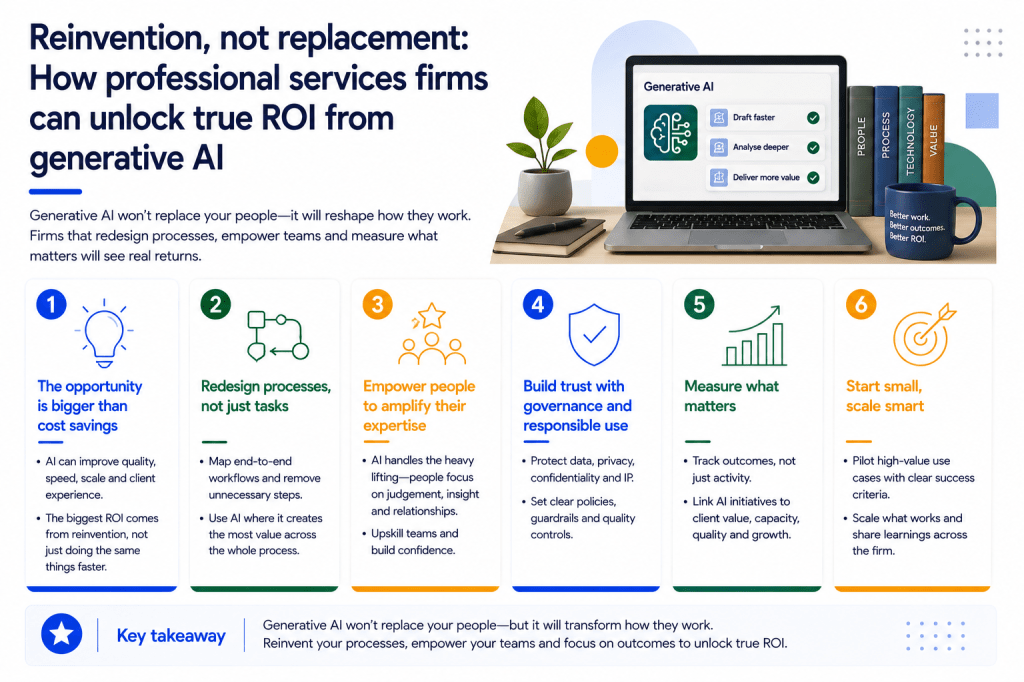
Key Takeaway: While initial generative AI adoption focused heavily on basic task efficiency and administrative time-savings, the next competitive frontier for New Zealand professional services firms requires a strategic pivot. The goal is no longer just doing things faster; it is about driving top-line growth, redesigning client value delivery, and modernising traditional billing models.
The narrative around generative artificial intelligence (GenAI) across the professional services sector – encompassing law, accounting, engineering, and corporate advisory – has shifted dramatically. A year ago, the primary focus for partners was understanding basic large language models (LLMs) and experimenting with minor productivity boosts. Today, the leading consensus among enterprise consultants is clear: if your firm is only using AI to summarise documents or draft basic emails, you are missing the real commercial opportunity.
Thomson Reuters’ 2026 AI in Professional Services Report found that the proportion of professionals whose organisations use generative AI increased from 22% in 2025 to 40% in 2026. Furthermore, over 90% of practitioners expect these tools to become central to their workflows within the next five years. Yet, a critical strategic vulnerability remains: only 18% of firms actively track their AI return on investment (ROI), leaving many partners exposed to subscription heavy tech-stacks without measurable financial metrics.
What is Generative AI for Professional Services and How Does it Impact Billing?
Generative AI for professional services refers to the integration of advanced large language models into specialised legal, financial, and advisory workflows to augment human expertise. This technology marks a shift away from legacy, rigid software toward systems that can cross-reference unstructured data, review multi-layered contracts, and draft complex advisory memos.
This shift directly challenges traditional professional structures, most notably the billable hour. As AI reduces the time required for routine technical research by up to 20% to 30%, firms relying solely on hourly billing risk cannibalising their own revenue. Forward-thinking firms are proactively transitioning toward fixed-fee structures, alternative fee arrangements (AFAs), and value-based pricing. By separating compensation from time spent, partners can monetise the speed of GenAI while charging premium rates for the high-level, human-led strategic judgment that the technology cannot replicate.
What is Shadow AI and What are the Operational Risks for Advisory Firms?
Shadow AI in professional services is the unauthorised use of public or consumer-grade artificial intelligence tools by staff to handle sensitive client data without IT oversight. Because generic generative AI interfaces are hyper-accessible, adoption is frequently driven from the ground up by junior employees looking to streamline their daily workloads.
For advisory, legal, and accounting firms, this democratisation creates severe compliance, liability, and brand vulnerabilities. Submitting proprietary client documents, financial records, or sensitive case files into public, free AI tools frequently violates client confidentiality agreements and local privacy laws, as that data can be used to train public models. Furthermore, generic models are prone to “hallucinations” – fabricated case law or flawed accounting interpretations – which can lead to severe professional negligence claims. Investing in secure, private, enterprise-grade AI environments with strict data boundaries is no longer an optional IT cost; it is a core risk-mitigation strategy.
How Can Partners Use Generative AI to Drive Firm Growth Beyond Efficiency?
Value-driven generative AI adoption is a business strategy focused on leveraging automated reasoning to capture market share, deepen client relationships, and introduce new advisory services. Instead of focusing strictly on internal cost-cutting, market leaders are deploying GenAI as a growth engine.
Firms are successfully unlocking top-line growth by deploying secure generative systems to:
- Offer real-time, predictive insights: Synthesising massive data sets – such as evolving tax codes, market disclosures, or regulatory shifts – to proactively advise clients on emerging risks before competitors do.
- Scale due diligence capabilities: Allowing transaction and M&A teams to process hundreds of data-room documents simultaneously, shifting from small-sample audits to comprehensive data reviews without increasing baseline headcount.
- Create hyper-personalised client experiences: Mining historical unstructured data (past client feedback, communication preferences, performance reviews) to deliver highly tailored advisory proposals at speed.
What This Means for Your Firm
Tomorrow’s market leaders are establishing their deployment strategies today. To move beyond low-risk pilot programmes and safely accelerate generative AI, professional services leaders should focus on four actionable pillars:
- Align AI capabilities with practice specialties: AI should not be an isolated IT initiative. Deployments must target specific practice bottlenecks – whether that means leveraging closed-loop legal research engines for litigation teams or automated data-extraction tools for audit and tax practices.
- Develop firm-wide AI literacy: Training must extend beyond technical staff to encompass all billing professionals. Practitioners must understand the limitations of LLMs, including automation bias (accepting AI outputs too readily because they look authoritative) and prompt bias.
- Build a centralised, high-ROI use case portfolio: Move away from fragmented, ad-hoc tool usage. Establish a formal pipeline where AI use cases are vetted for accuracy, scalability, and direct alignment with the firm’s overarching commercial goals.
- Enforce a robust Responsible AI framework: Maintaining trust with clients, boards, and regulatory bodies requires strict governance. Firms must balance rapid technological integration with rigorous oversight concerning data sovereignty, algorithmic verification, and strict human-in-the-loop validation.
The technology is ready, and client expectations are changing rapidly. The ultimate differentiator for New Zealand’s professional services firms will not be access to generative AI, but the speed, governance, and business-model adaptability with which they execute it.
Related reading
- How NZ firms are scaling custom generative AI
- The new landscape of specialised legal AI
- Our AI governance and advisory services