Key takeaways
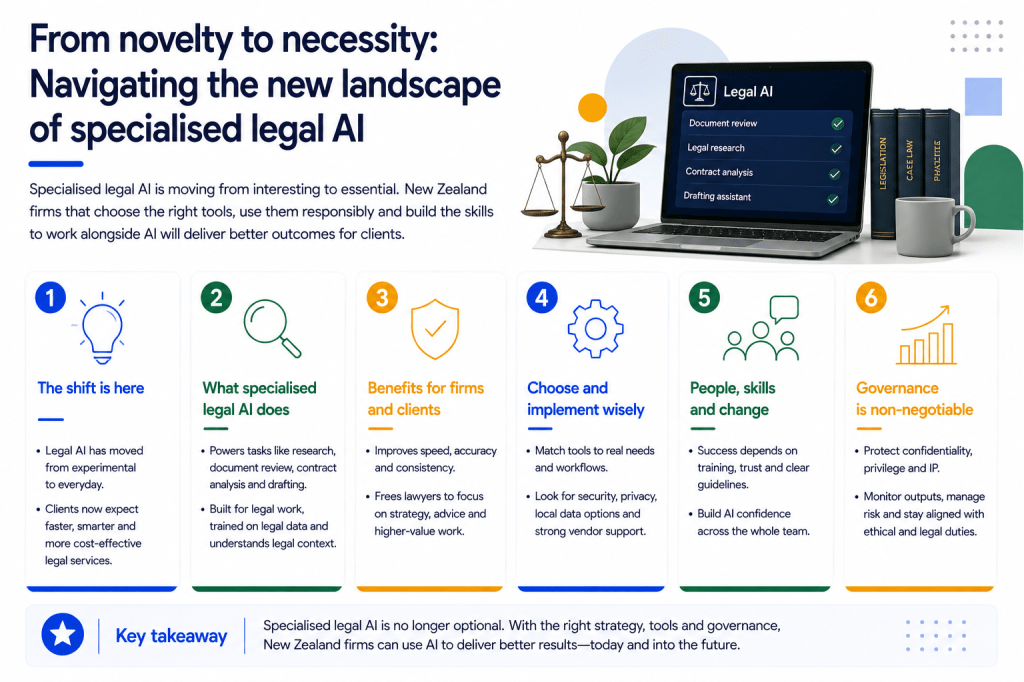
- Specialised legal AI has matured from novelty to a genuine client expectation.
- The landscape now spans workflow hubs, advanced-reasoning tools and verified legal-research platforms – each with different strengths.
- Firms should match the right tool to each task and adopt them with proper verification and oversight.
The initial wave of legal AI adoption was driven by curiosity and experimentation. Today, that novelty has worn off, replaced by a demanding reality: clients expect faster turnaround times, fixed-fee structures are squeezing traditional billable hours, and regulatory bodies are enforcing strict guidelines around the use of automated tools in courtrooms and corporate filings.
To stay competitive, law firms are deploying highly specialised legal AI suites. These platforms are generally divided into three strategic categories based on their functional architecture.
1. The Workflow and Collaborative Hubs
These platforms are designed to replace the administrative “grunt work” of legal practice, keeping lawyers inside a unified, shared environment where multiple team members can collaborate on a single matter.
- Legora: Positioned as a rapidly growing collaborative workspace built specifically for law firms and in-house teams. Its standout capability is Tabular Review, which allows teams to process hundreds of data-room documents simultaneously, extracting key data points into structured grids to flag anomalies or risks. Backed by tight, direct integrations into Microsoft Word and Outlook, it embeds AI directly into a lawyer’s existing daily workflow.
2. Advanced Reasoning and Cross-Jurisdictional Analysis
For complex litigation, cross-border M&A, and sophisticated corporate drafting, firms are leveraging platforms built for deep contextual understanding across massive, unstructured data sets.
- Harvey: Built on customised OpenAI models and backed by massive global institutional investment, Harvey has become a staple for elite global law firms and corporate legal departments. It excels in nuanced legal reasoning, multi-jurisdictional contract analysis, and generating complex, bespoke drafts from scratch.
- CoCounsel (by Casetext / Thomson Reuters): Powered by GPT-4, CoCounsel acts as a high-speed AI legal assistant. It is heavily utilised by transactional and litigation teams alike for rapid document review, preparing comprehensive deposition lines of questioning, and scanning massive discovery sets to identify critical factual inconsistencies.
3. The Verified Research Powerhouses
A major risk of generic generative AI is the phenomenon of “hallucinations”-fabricated case law that can lead to severe professional sanctions. To combat this, the industry’s legacy information giants have built closed-loop, conversational engines anchored strictly to primary legal databases.
- Lexis+ AI: LexisNexis’s conversational AI assistant allows users to run complex, natural-language research queries. Crucially, it drafts synthesised legal memos drawing only from Lexis’s verified primary law databases, ensuring every assertion is backed by precise, hyperlinked citations.
- Westlaw Precision AI: Thomson Reuters’ equivalent offering pairs generative AI capabilities with their gold-standard editorial notes and proprietary Key Number search features. The result is a dramatic acceleration in statutory and case law research without sacrificing historical editorial accuracy.
What This Means for Your Firm
Selecting the right tool depends entirely on your firm’s primary practice bottlenecks. Investing in a powerful litigation assistant will yield low returns if your primary overhead lies in manual M&A due diligence.
Aligned Deployment Strategies
- For Transactional and Corporate M&A Teams: Prioritise tools like Legora or Harvey. The ability to turn a chaotic, 500-document data room into a clean, risk-flagged spreadsheet overnight changes the economics of deal delivery.
- For Litigation and Dispute Resolution: Focus on CoCounsel or the AI-driven research layers of Westlaw and Lexis+. The immediate ROI here is found in reducing the time required for discovery analysis and drafting initial case summaries.
- The Governance Mandate: Regardless of the platform chosen, data security and confidentiality remain paramount. Ensure any vendor contract guarantees a multi-tenant architecture where client data is completely ring-fenced and never used to train public LLM models.
The ultimate goal of legal AI is not to replace human judgement, but to clear the administrative bottleneck – allowing lawyers to spend less time digging through documents and more time delivering strategic advice.
Related reading
- What the judiciary’s AI guidelines mean in practice
- How NZ firms are scaling custom generative AI
- Our guide to the generative AI landscape