Key takeaways
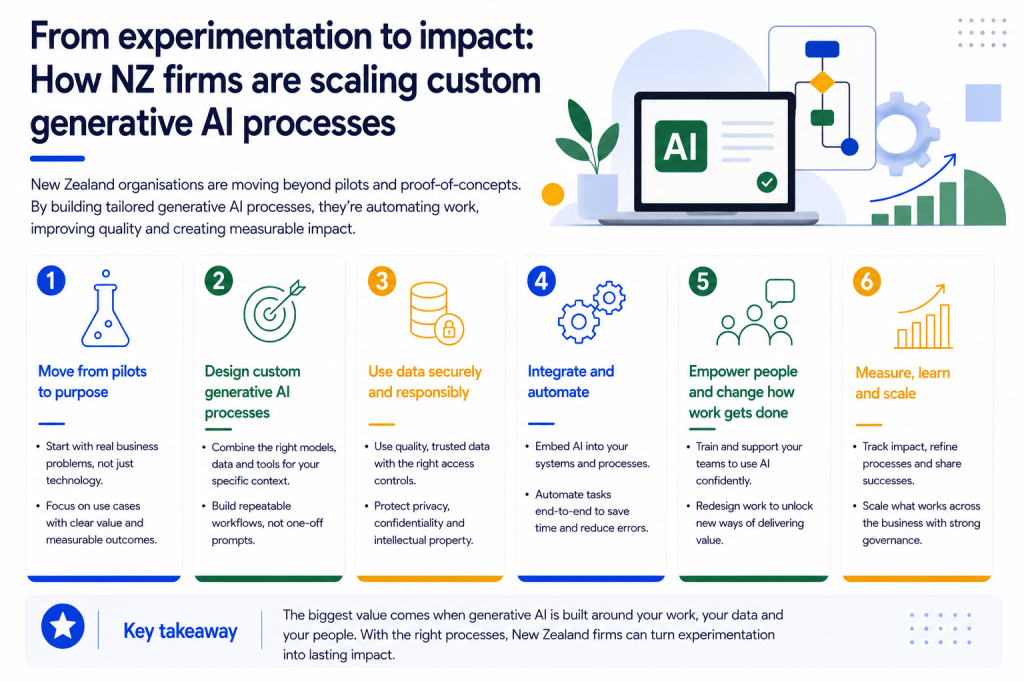
- Firms are moving beyond one-off AI drafting to custom, embedded generative AI processes that scale.
- Retrieval-augmented generation (RAG) lets firms apply AI to their own data while protecting confidentiality.
- Real commercial ROI comes from customising and automating advisory workflows – not just saving admin time.
The landscape of generative artificial intelligence (GenAI) in the professional services sector has matured rapidly. Initially, firm leaders viewed GenAI through a narrow lens: a novel tool for drafting emails or summarising single documents. Today, enterprise consultants and industry data reveal a much more sophisticated reality. The strategic imperative is no longer simply buying an off-the-shelf GenAI subscription; it is fundamentally redesigning how a firm’s proprietary data interacts with LLM ecosystems.
This transition is defined by a shift from ad-hoc prompting to institutionalised GenAI processes. To move from basic productivity gains to true operational impact, professional services firms must focus on three core generative architectures.
What is Retrieval-Augmented Generation (RAG) and How Does it Safeguard Firm Data?
Retrieval-Augmented Generation (RAG) is a technical architecture that optimizes LLM outputs by querying a secure, verified internal database before generating a response.
A major barrier to enterprise GenAI adoption is the risk of “hallucinations” – instances where public models fabricate legal precedents or accounting rules. Furthermore, pasting sensitive files into public AI tools violates client confidentiality.
RAG can reduce hallucination risk by grounding responses in approved sources. It does not eliminate inaccuracies, inappropriate disclosure or the need for human review. When a professional inputs a query, the system searches the firm’s private cloud – containing historical advice, templates, and trusted research – to gather factual context. The generative model then synthesises this internal information into a structured draft, ensuring every output is grounded strictly in the firm’s own verified expertise.
What are Automated Generative Workflows and How Do They Transform Advisory Tasks?
Automated generative workflows are end-to-end operational processes that string together multiple generative AI tasks to automate complex documentation and technical reviews.
Instead of requiring a professional to manually prompt an AI step by step, these advanced processes link generative actions together behind the scenes. For a professional services firm, this turns intensive text-based workflows into automated routines.
Key generative processes include:
- Multi-Document Synthesis: Automatically scanning hundreds of pages of unstructured data – such as complex financial disclosures or cross-border contracts – to draft a comprehensive compliance gap analysis.
- Bespoke Document Drafting: Generating highly detailed, initial advisory memos or technical reports that mirror the firm’s specific tone, structure, and formatting standards out of raw client meeting transcripts.
- Dynamic Response Generation: Parsing incoming client inquiries, mapping them against internal knowledge bases, and preparing complete, technically accurate response drafts for partner review.
How Can Firms Customise Generative AI Tools to Maximise Commercial ROI?
Generative AI customisation is a strategic framework where organisations fine-tune language models or build proprietary prompt libraries to deliver distinct, high-value client advisory services.
If a firm merely relies on generic, out-of-the-box generative tools, it will only see minor administrative time-savings. To unlock actual return on investment, GenAI must be tailored to the firm’s unique intellectual property.
Market leaders achieve this by:
- Proprietary Fine-Tuning: Training open-source language models on decades of specialised, anonymised case histories and corporate advisory precedents, creating a tool that understands niche regulatory environments better than any public alternative.
- Building Institutional Prompt Libraries: Standardising the exact parameters, constraints, and personas the firm’s professionals use to interact with GenAI, ensuring consistent, high-quality outputs across every practice group.
What This Means for Your Firm
Implementing generative AI is no longer a technology experiment; it is a core business operational challenge. To safely accelerate your generative workflows, professional services leaders should focus on four actionable pillars:
- Prioritise the RAG Architecture: Do not deploy generic GenAI tools across the firm. Invest in a Retrieval-Augmented Generation structure to keep client data secure and eliminate model hallucinations.
- Map Out Your Text-Heavy Bottlenecks: Identify the specific documentation, research, and drafting processes that consume the most billable hours, and target these areas for automated generative workflows.
- Establish a Shared Prompt Infrastructure: Move away from individual staff members writing their own ad-hoc prompts. Create an institutional library of verified, compliant prompts to standardise the quality of your firm’s outputs.
- Enforce Strict Human-in-the-Loop Validation: Maintain absolute trust by ensuring no generative output is ever sent to a client or regulator without rigorous verification and signing-off by a qualified professional.
The technology is ready, and client expectations are changing. The ultimate differentiator for New Zealand’s professional services firms will not be whether they use generative AI, but the security, customisation, and process design they wrap around it.
Related reading
- Unlocking real ROI from generative AI
- The new landscape of specialised legal AI
- Our guide to the generative AI landscape