A plain English guide to the technology behind ChatGPT, Claude, Gemini, Copilot, and other AI tools
Generative AI is developing quickly, and so is the language used to describe it. Terms such as large language model, neural network, token, transformer, grounding and AI agent are now appearing in business discussions, product descriptions and internal policies. You do not need to be a technical specialist to understand what these terms mean. However, anyone responsible for approving, governing or using AI should have a basic understanding of how the technology works.
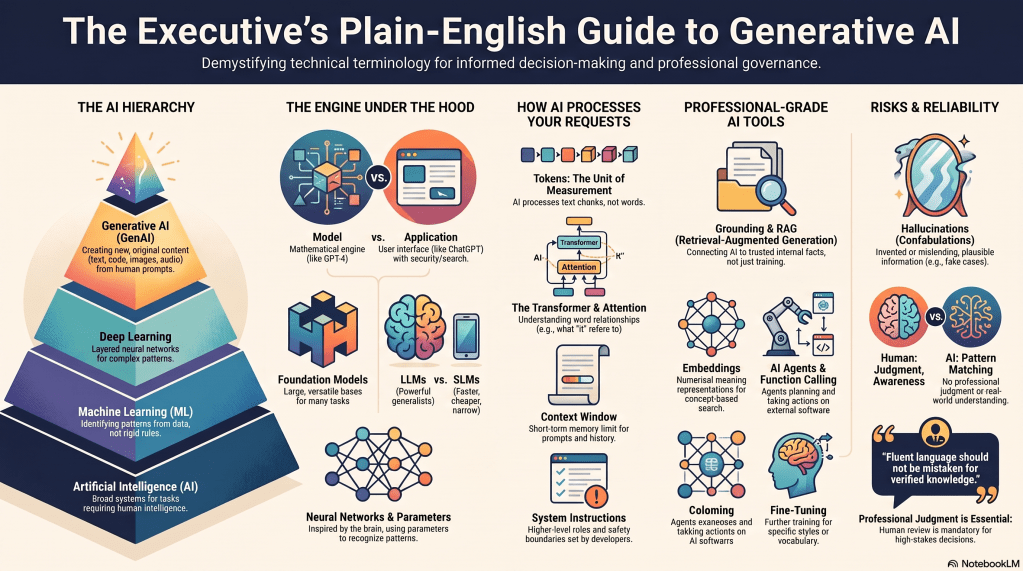
This guide explains the main concepts in plain English. Also see this handy infographic for a visual representation.
What is generative AI?
Generative artificial intelligence, usually shortened to generative AI or GenAI, is a type of machine learning that can create new content.
Depending on the tool, that content may include:
- written text
- summaries and analysis
- software code
- images and illustrations
- audio and speech
- music
- video
- presentations
- structured data
Traditional software generally follows defined rules. A spreadsheet performs a calculation using a formula. A document management system stores and retrieves files. A search engine locates information that already exists. Generative AI works differently. It learns patterns and relationships from large amounts of data, then uses those patterns to produce a new response to a request. That request is usually called a prompt. Generative AI does not simply copy and paste an existing answer. It generates an output based on the information it was trained on, the instructions it has been given and any additional information it can access.
How does generative AI fit within artificial intelligence?
Artificial intelligence is the broad term used for computer systems designed to perform tasks that normally require some form of human intelligence. Within AI sits machine learning. Machine learning allows a system to identify patterns from examples and data, rather than requiring a developer to write a separate rule for every possible situation. Most modern generative AI tools use a more advanced form of machine learning called deep learning. Deep learning uses layered neural networks to identify complex patterns across very large datasets. A simple way to think about the relationship is:
Artificial intelligence is the broad field.
Machine learning is an approach that allows systems to learn patterns from data.
Deep learning uses large, layered neural networks to learn more complex patterns.
Generative AI uses these techniques to create new content.
What is an AI model?
An AI model is the underlying mathematical system that processes information and produces an output. The model is not the same thing as the application people use. For example, ChatGPT is a product and user interface. Behind it are one or more AI models. Microsoft Copilot, Google Gemini and other AI products also combine models with search, document access, security controls, connectors and other software features. This distinction matters when assessing an AI tool. Two products may use similar underlying models but handle user information, access permissions, retention, administration and security very differently.
What is a neural network?
A neural network is a type of machine learning architecture designed to identify complex patterns in data. It is made up of connected mathematical units, often called nodes or artificial neurons. Information passes through layers of these nodes, with each layer identifying different features, relationships or patterns. During training, the network adjusts large numbers of internal numerical values so its predictions become more accurate. The term is loosely inspired by the structure of the human brain, but a neural network is not a digital brain. It is a mathematical system built to recognise and reproduce patterns.
What is deep learning?
Deep learning refers to neural networks that contain many processing layers. Earlier layers may identify simple patterns. Later layers combine those patterns into more complex relationships. For an image model, early layers might recognise lines, colours and shapes. Later layers may identify objects, people, locations or visual styles. For a language model, early layers may identify relationships between words and sentence structures. Later layers can work with broader meaning, context, tone and subject matter. The word “deep” refers to the number and structure of the layers, not to the system having deep human understanding.
What is a foundation model?
A foundation model is a large AI model trained on broad and varied data so it can support many different tasks. Instead of being built for one narrow purpose, a foundation model may be able to:
- answer questions
- draft and edit documents
- summarise information
- analyse files
- translate languages
- write software code
- interpret images
- generate new media
Organisations can use a foundation model as the base for their own applications, assistants or specialised workflows. It may then be given additional instructions, connected to business information or adjusted for a particular type of work.
What is a large language model?
A large language model, commonly called an LLM, is an AI model trained to work with language. LLMs are trained using very large collections of text and other information. Through this process, they learn statistical relationships between words, phrases, concepts and structures. When generating text, an LLM predicts which piece of language is most likely to come next, taking into account the prompt and the content already generated. It then repeats this process, building the response piece by piece. This apparently simple prediction process can produce sophisticated outputs because the model has learned an enormous number of relationships from its training data.
LLMs can support tasks such as:
- drafting correspondence
- summarising documents
- extracting information
- comparing clauses
- answering questions
- translating content
- writing and reviewing code
- brainstorming
- classifying information
An LLM does not automatically know whether its answer is true. It produces a response that is statistically plausible based on the information and instructions available to it.
What is a small language model?
A small language model, or SLM, works on similar principles to an LLM but is smaller and generally requires less computing power.
Small models may be useful when an organisation needs:
- faster responses
- lower operating costs
- local or on-device processing
- a model designed for a narrow task
- greater control over where processing occurs
A larger model is not automatically the best model. The right choice depends on the task, the required accuracy, cost, privacy, speed and how the model will be used.
What is a transformer?
A transformer is the main architecture behind most modern language models. Transformers are designed to consider the relationships between different parts of an input. They use a technique called attention to work out which words or pieces of information are most relevant to one another.
Consider this sentence:
The adviser reviewed the report before sending it to the client.
To interpret what “it” refers to, the model needs to recognise that “it” is more closely connected to “the report” than to “the adviser” or “the client”. Attention helps the model identify these relationships across a sentence, document or conversation. Transformers can process many relationships at once and build increasingly complex representations of the information as it moves through the model’s layers.
What are tokens?
AI language models do not process text in exactly the same way people read words. They divide text into smaller units called tokens.
A token might be:
- a complete word
- part of a word
- punctuation
- a number
- a space or formatting element
For example, an uncommon or complex word may be divided into several smaller tokens. Tokens matter because AI services commonly measure usage, processing limits and cost by the number of tokens sent to and generated by the model. Longer prompts, large documents and detailed responses use more tokens.
What is a context window?
The context window is the amount of information a model can consider during a particular interaction.
It may include:
- the user’s prompt
- earlier messages in the conversation
- uploaded documents
- system instructions
- retrieved business information
- the model’s response
The size of a context window is normally measured in tokens. A larger context window allows the model to work with more information at once. However, a large context window does not guarantee that every detail will be identified, correctly interpreted or given equal weight. A context window should not be confused with permanent memory. Information being available during one interaction does not necessarily mean the model will remember it in another interaction.
What is a prompt?
A prompt is the instruction or information provided to a generative AI model.
A prompt may be a simple question:
Summarise this email.
Or it may include detailed instructions:
Summarise this report for a board audience. Focus on the five most significant risks, use plain English, and identify any matters that require a decision.
Prompts can include more than text. Depending on the tool, users may provide:
- images
- documents
- spreadsheets
- audio
- video
- screenshots
- links
- examples of the required output
Clear instructions, appropriate context and examples generally improve the usefulness of the response. This is sometimes called prompt design or prompt engineering. It is best understood as giving the model a clear brief, not using secret commands or special technical language.
What are system instructions?
System instructions are higher-level rules provided to the model by the application developer, service provider or organisation.
They can influence matters such as:
- the model’s role
- the style of its responses
- information it must not disclose
- tasks it is permitted to perform
- sources it should use
- situations requiring human approval
- safety and content restrictions
A user’s prompt operates within these wider instructions. For example, an organisation may configure an internal assistant to answer only from approved company documents and to state when the available information is insufficient.
What are parameters?
Parameters are the internal numerical values a model learns during training. They help determine how the model responds to different patterns and inputs. When people refer to a model having billions of parameters, they are describing the scale of the mathematical relationships within the model. They are not describing billions of stored documents or individual facts. More parameters can allow a model to represent more complex relationships, but model size alone does not determine quality, accuracy or suitability. Training data, model design, evaluation, safety controls and the way the model is implemented also matter.
What is training?
Training is the process used to develop an AI model. During training, the model processes large amounts of data and repeatedly attempts to make predictions. Its internal parameters are adjusted to reduce the difference between its predictions and the expected result. For a language model, this often involves predicting missing or subsequent tokens across very large collections of text. Training a foundation model requires significant data, computing power, specialist expertise and time. Most organisations will not train a major foundation model themselves. They will use an existing model and configure or connect it for their own purposes.
What is inference?
Inference is what happens when a trained model is used. The training stage creates the model. Inference is the process of giving that model a prompt and receiving a response. When someone asks an AI assistant to draft an email, analyse a contract or generate an image, the model is performing inference.
What is multimodal AI?
A multimodal model can work with more than one type of information.
Depending on its capabilities, a multimodal model may be able to process and generate combinations of:
- text
- images
- speech
- audio
- documents
- video
- software code
For example, a user may upload a photograph, ask the model to describe what it shows and then request a written report based on the image. Multimodal systems are important because professional work is rarely limited to plain text. Information may be contained in scanned documents, charts, recordings, photographs, presentations and spreadsheets.
What are embeddings?
Embeddings are numerical representations of meaning. An embedding model converts content, such as a sentence, document or image, into a set of numbers. Content with similar meaning is represented by numbers that are closer together mathematically. This allows an AI system to find relevant information based on meaning, rather than relying only on matching exact words. For example, a traditional keyword search for “ending a client relationship” may not find a document titled “customer disengagement procedure”. An embedding-based search may recognise that the two phrases relate to similar concepts.
Embeddings are commonly used in:
- semantic search
- document retrieval
- recommendation systems
- knowledge bases
- RAG systems
- document comparison and classification
What is grounding?
Grounding connects an AI model’s response to an external source of information.
That source might include:
- a firm’s document management system
- an approved policy library
- a client file
- a trusted database
- legislation or regulatory guidance
- current web search results
Without grounding, a model generally relies on its training, the current prompt and the information already provided in the conversation. Grounding gives the model access to more relevant or current information and can make it easier to provide supporting sources. It can reduce the risk of incorrect answers, but it does not remove the need for review. The model may still select the wrong source, overlook an important detail or misinterpret the information.
What is retrieval-augmented generation?
Retrieval-augmented generation, usually shortened to RAG, is a common method of grounding an AI system.
A RAG system normally works in three broad stages:
- It searches an approved collection of documents or information.
- It retrieves the material most relevant to the user’s request.
- It provides that material to the language model so the model can prepare its response.
For example, a law firm could use RAG to allow an internal assistant to search approved precedents and policies. An accounting firm could connect an assistant to internal guidance, procedure manuals and technical updates. RAG does not normally retrain the underlying model. It provides selected information to the model at the time the question is asked.
What is fine-tuning?
Fine-tuning is the process of further training an existing model using additional examples for a particular purpose.
It may be used to help a model:
- follow a consistent output structure
- use specialised terminology
- classify information in a particular way
- perform a repeated task more reliably
- adopt a particular communication style
Fine-tuning changes aspects of the model itself. This differs from RAG, which supplies relevant information when the model is being used. For many professional firms, good instructions, approved templates and RAG may be more practical than fine-tuning. The right approach depends on the use case, volume, complexity and required level of consistency.
What is an AI agent?
An AI assistant normally responds to a request. An AI agent goes further by planning and carrying out a sequence of actions to achieve an objective.
Depending on how it is configured, an agent may be able to:
- search for information
- read documents
- call external software
- create or update records
- prepare a report
- send a message
- check whether a task was completed
- decide what step to take next
For example, an agent might receive an instruction to review incoming client enquiries, check them against a conflict database, prepare a summary and create a draft response. Agents can be useful, but they introduce greater risk because the AI is no longer only producing content. It may also be taking actions. Access permissions, logging, approval points, testing and human oversight become particularly important.
What is function calling?
Function calling allows an AI model to request the use of an external tool or software function.
The model might determine that it needs to:
- check a calendar
- search a database
- calculate a figure
- retrieve a client record
- create a document
- call another system through an API
The application performs the action and returns the result to the model. Function calling is one of the main ways AI assistants and agents move beyond conversation and interact with business systems.
What is an AI hallucination?
A hallucination occurs when a generative AI system produces incorrect, invented or misleading information and presents it as though it were reliable.
Examples include:
- inventing a court case
- providing a false quotation
- citing a publication that does not exist
- making up a contractual clause
- stating an incorrect calculation
- describing an event that did not happen
- confidently misinterpreting a document
The more formal term used by the United States National Institute of Standards and Technology is confabulation. Hallucinations occur because a generative model is designed to produce a plausible response. It is not automatically checking each statement against an authoritative source. Grounding, RAG, better prompts and specialist tools can reduce the risk, but no general-purpose generative AI system should be assumed to be completely accurate.
Does generative AI understand information?
Generative AI can process language, identify relationships, follow instructions and produce responses that appear highly informed. Whether this should be described as “understanding” depends on how the term is being used. The safer practical position is that AI models identify and apply complex patterns. They do not have human experience, professional judgement, accountability or awareness of the real-world consequences of their advice. Fluent language should not be mistaken for verified knowledge.
Is generative AI the same as search?
No. A conventional search engine locates and ranks existing information. A generative AI model creates a response. Some modern AI assistants combine both functions. They may search the web or an internal document collection, retrieve relevant sources and then use a language model to summarise or explain what was found. This can be useful, but the generated summary should still be checked against the original sources.
Does an AI model contain a copy of its training data?
Not in the same way that a document repository stores files. During training, the model adjusts its internal parameters to represent patterns and relationships found across its training material. It does not normally retrieve an original training document when answering a question. However, models can sometimes reproduce or reveal parts of their training data, particularly where information appeared repeatedly or where the system is deliberately manipulated. This creates privacy, confidentiality and intellectual property considerations.
Why human review still matters
Generative AI can produce useful work very quickly. It can also produce an answer that is incomplete, biased, outdated or simply wrong.
Professional judgement remains essential where the output may affect:
- a client
- a legal position
- financial advice
- a regulatory obligation
- an investigation
- confidential information
- an important business decision
- an external communication
The appropriate level of review should reflect the risk of the task. Using AI to suggest alternative headings for an internal presentation is different from relying on it to interpret a contractual obligation or advise a client.
The practical takeaway
Generative AI is best treated as a powerful tool for supporting human work. It can draft, summarise, analyse, create and assist at considerable speed. When connected to approved information and business systems, it can also support more sophisticated professional workflows. But it is not automatically accurate, confidential, current or appropriate for every task.
Professional firms do not need every employee to become an AI engineer. They do need people to understand the basic technology, use approved tools, protect client information and apply proper professional judgement.
That is the foundation for putting generative AI to work safely, practically and with the right governance in place.

