Key takeaways
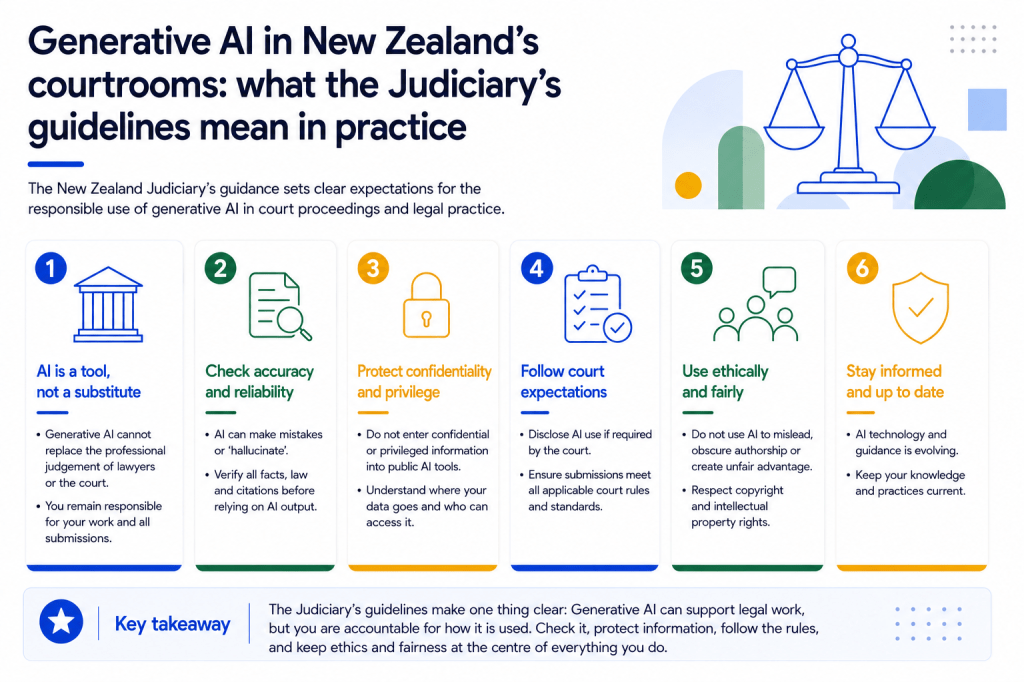
- New Zealand’s judiciary guidelines add no new rules – they reinforce existing duties as they apply to generative AI.
- Confidentiality, suppression and AI accuracy (hallucinations) are the sharpest risks in legal use.
- The guidance applies across the justice system, from judges to self-represented litigants.
Generative AI (GenAI) has moved from novelty to everyday tool with remarkable speed, and the legal profession is no exception. Recognising both the momentum and the risks, the New Zealand judiciary has issued a coordinated set of guidelines governing GenAI use in courts and tribunals – one of the earliest judicial responses of its kind.
Issued on 7 December 2023 by the judiciary’s Artificial Intelligence Advisory Group and approved by the Heads of Bench Committee, the guidance comes in three tailored versions:
- Judges, judicial officers and their support staff (including clerks and legal research counsel)
- Legal practitioners
- Non-lawyers, including self-represented litigants and lay advocates
The unifying principle: any use of GenAI must be consistent with the judiciary’s overarching obligation to protect the integrity of the administration of justice. Everything else flows from that starting point.
1. No New Rules – Just a Firm Reminder of the Old Ones
Perhaps the most important message for practitioners is that the guidelines do not create a new regulatory regime. Instead, they make clear that existing professional obligations apply with full force to this new technology.
Lawyers remain bound by the Lawyers and Conveyancers Act 2006 and the Conduct and Client Care Rules, including the fundamental duties to uphold the rule of law, to facilitate the administration of justice, and – critically – never to mislead the court.
In practical terms, a lawyer cannot outsource accuracy to a chatbot. If a GenAI tool produces a citation, a legal summary, or a factual assertion, the lawyer who puts that material before the court owns it entirely. The guidelines are explicit: all AI-generated information, including legal citations, must be verified by an appropriately qualified person before it is used in proceedings.
2. Understanding the Technology – and Its Failure Modes
The guidance devotes significant attention to demystifying GenAI. Chatbots are not search engines drawing on authoritative databases; they are prediction engines. Large language models generate the statistically most likely sequence of words in response to a prompt, which means output can look polished and authoritative while being entirely wrong.
The guidelines catalogue the known failure modes with unusual candour:
- Fabrication (“hallucination”): inventing cases, citations and quotations that do not exist – the failure mode behind well-publicised overseas incidents of lawyers filing submissions built on fictitious authorities.
- Jurisdictional errors: misstating the law, or applying overseas law as though it governed in New Zealand.
- False confidence: confirming the accuracy of information that is in fact false, often in fluent and assured language.
The local context deficit
The judiciary flags a distinctly local concern: the major global AI models appear to have had limited exposure to New Zealand legal materials in their training data. A tool that performs plausibly on questions of US or English law may be far less reliable on New Zealand statutes, case law and court procedure.
The guidelines further note that these systems generally do not reflect New Zealand’s cultural context, including the specific values and practices of Māori and Pasifika communities – an ethical dimension that sets this guidance apart from many overseas equivalents.
3. Confidentiality and Suppression: The Sharpest Edge
The most operationally significant restriction concerns what goes into these tools rather than what comes out.
The default rule is stark: do not enter anything into a public GenAI chatbot that is not already in the public domain. Private, confidential, suppressed or legally privileged information is strictly off-limits.
The reasoning is straightforward. Many public chatbots retain user inputs and may draw on them in responses to other users. In a legal context, that creates a direct pathway to breaching suppression orders, statutory publication prohibitions, privilege and client confidentiality – with potentially serious consequences.
If an inadvertent disclosure does occur, the guidelines direct users to respond as they would to any other unintended disclosure – for example, promptly notifying the court registry if a suppression order may have been breached. Practical mitigations, such as disabling chat history where the platform allows it, are also recommended.
The guidance anticipates that firms may eventually deploy in-house, privacy-protecting GenAI systems, which would ease some of these concerns. The underlying legal obligations around privilege, suppression and publication, however, remain unchanged regardless of the technology used.
4. Disclosure: A Pragmatic Middle Path
On the contentious question of whether AI use must be disclosed to the court, New Zealand has adopted a notably pragmatic stance:
- No blanket disclosure requirement. Lawyers are not required to disclose GenAI use as a matter of course. The logic is that if the guidelines have been followed – above all, if outputs have been properly verified – the key risks have already been addressed.
- Discretionary inquiry retained. Courts and tribunals may still ask about, or require disclosure of, GenAI use in particular cases.
This contrasts with the blanket disclosure rules adopted in some overseas jurisdictions.
5. Broad Application Across the Justice System
The reach of the guidelines is extensive, spanning the full New Zealand court and tribunal system:
- Senior courts: Supreme Court, Court of Appeal, High Court
- District and specialist courts: the District Court and its divisions, Māori Land Court, Māori Appellate Court, Employment Court, Environment Court and Coroners Court
- Tribunals: the Waitangi Tribunal, alongside a long list of civil, administrative and professional disciplinary tribunals and authorities
For judges and their support staff, a parallel set of guidelines applies the same core principles to judicial work.
Summary Takeaway
| What GenAI can do | What GenAI cannot do |
|---|---|
| Assist with drafting, summarising and reformatting | Replace human professional judgement |
| Serve as a preliminary research starting point | Be trusted with confidential, privileged or suppressed material |
| Speed up routine document work | Act as an unchecked source of legal citations or statements of law |
The New Zealand judiciary has opted for education over prohibition. The guidelines do not ban generative AI; they acknowledge its legitimate uses while drawing bright lines around confidentiality and insisting on human verification of everything the technology produces. For practitioners, the message is clear: GenAI can be a useful assistant, but it is never the responsible party. The lawyer signing the document remains accountable for every word in it.
This article is based on the Guidelines for Use of Generative Artificial Intelligence in Courts and Tribunals, issued by the Courts of New Zealand on 7 December 2023. It is general commentary only and does not constitute legal advice.
Related reading
- The new landscape of specialised legal AI
- AI governance and accountability in New Zealand
- Our AI governance and advisory services