Key takeaways
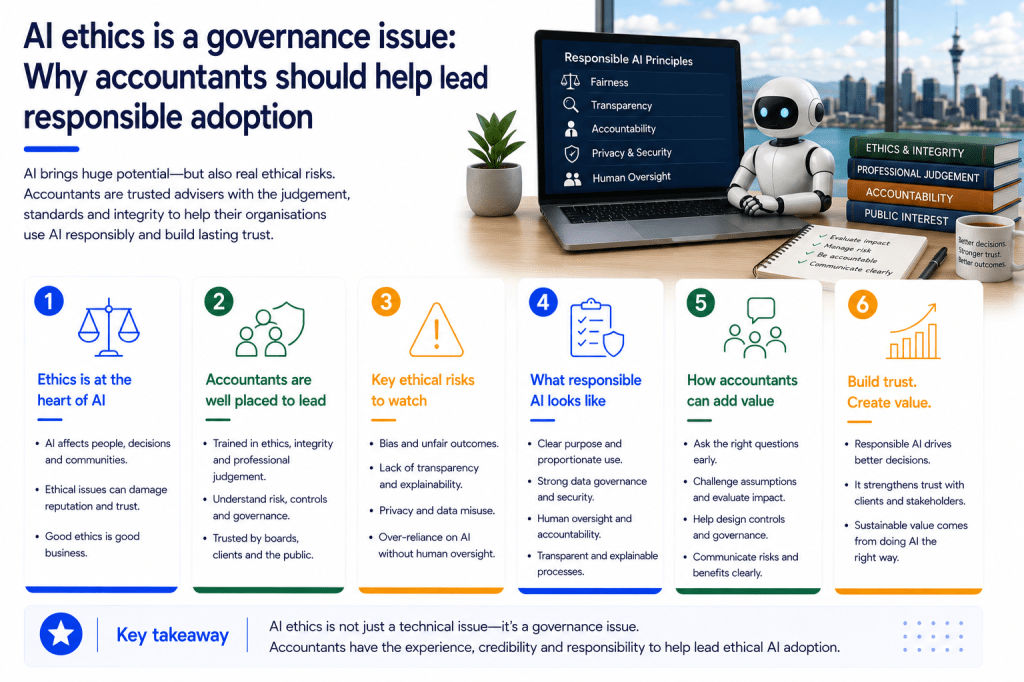
- Ethical AI adoption is not only a technology issue. It affects environmental impact, employee and customer rights, privacy, transparency and organisational accountability.
- Accountants and finance professionals are well placed to help govern AI because their existing duties already require integrity, objectivity, confidentiality, professional competence and careful judgement.
- Policies alone are not enough. Organisations need clear ownership, approved use cases, vendor checks, human oversight, documented decisions and ongoing monitoring.
Artificial intelligence has changed significantly since Chartered Accountants Australia and New Zealand and ACCA published Ethics for Sustainable AI Adoption: Connecting AI and ESG in 2021.
The tools are more capable, generative AI is widely accessible, and employees can now introduce AI into an organisation simply by opening a browser. But the report’s central message has become more relevant, not less: the value of AI will depend on whether organisations adopt it ethically and sustainably.
Based on a global survey of 5,723 accounting and finance professionals, along with interviews and an online discussion group, the research examined AI through the connected lenses of environmental, social and governance considerations. It argued that accountants and finance professionals have an important role in ensuring AI creates sustainable, long-term value rather than short-term efficiency accompanied by unmanaged risk.
AI and ESG belong in the same conversation
AI governance is sometimes treated as a narrow combination of privacy, cybersecurity and legal compliance. Those issues matter, but they do not capture the full impact of AI.
The CA ANZ and ACCA report places AI within the broader environmental, social and governance framework.
From an environmental perspective, AI systems consume energy through data storage, model training, processing and cooling infrastructure. Organisations should therefore consider efficiency, energy use and the environmental practices of technology providers when selecting AI systems. The report also identifies a positive role for AI, including analysing large volumes of sustainability data and testing whether environmental claims are supported by underlying evidence.
The social dimension includes how AI affects employees, customers and members of the public. Automated recruitment, employee monitoring, customer profiling and algorithmic decision-making can create unfair or discriminatory outcomes. Even where an AI tool improves efficiency, organisations still need to ask who benefits, who may be disadvantaged and whether affected people can understand or challenge a decision.
The governance dimension covers responsibility, oversight, policies, data quality, vendor management, documentation, model performance and what happens when a system fails. These are not abstract ethical questions. They determine whether an organisation can explain how its AI is being used and demonstrate that appropriate controls were operating.
Accountants are natural AI governance leaders
The report argues that the accounting profession is well placed to help organisations navigate responsible AI adoption because ethical judgement is already central to professional practice.
The established principles of integrity, objectivity, professional competence and due care, confidentiality, and professional behaviour map closely to common AI risks.
For example:
- Integrity requires honest communication about where AI is being used and what it can and cannot reliably do.
- Objectivity requires professionals to challenge biased outputs, inflated vendor claims and unrealistic assumptions about cost or performance.
- Professional competence and due care require enough understanding of an AI system to question its use, limitations and controls.
- Confidentiality applies when client, employee or commercially sensitive information is entered into AI systems.
- Professional behaviour requires compliance with existing legal and professional obligations, even where those rules do not specifically mention AI.
This does not mean accountants must become machine-learning engineers. It means they need enough knowledge to ask informed questions and to avoid transferring responsibility to a system simply because its output appears sophisticated.
That role remains important in 2026. CA ANZ has more recently reported that accountants continue to identify data security, cyber risk and ethical governance as major barriers to AI adoption. It recommends clear governance frameworks, transparency around data use, human oversight and training that helps professionals apply judgement alongside AI. (CA ANZ)
What the New Zealand results showed
The report contains a separate historical snapshot of its New Zealand respondents.
At the time of the 2021 research:
- 14 percent said their organisation had implemented an ethical framework for AI use;
- 24 percent said their organisation had considered relevant regulatory requirements;
- 59 percent reported having a basic understanding of how an AI algorithm worked;
- 52 percent identified data collection as a major data-quality challenge;
- 45 percent identified secure storage as a major data-confidentiality challenge.
Historical New Zealand snapshot: The research suggested that interest in AI was developing faster than the governance structures needed to support it.
These figures should not be treated as a current measure of New Zealand organisations. They come from research conducted in 2021, before the widespread availability of generative AI. They are still useful because they identify governance weaknesses that many organisations continue to encounter: limited oversight, uncertain regulatory understanding, weak data controls and insufficient internal capability.
The environment has also moved forward. New Zealand released its first national AI strategy and voluntary Responsible AI Guidance for Businesses in July 2025. The guidance is intended to help organisations adopt AI with greater confidence while managing risk responsibly. (MBIE)
The practical question for organisations is therefore no longer whether guidance exists. It is whether the guidance has been translated into everyday decisions, controls and responsibilities.
Responsible AI must become an operating process
Many organisations begin with an AI policy. That is a sensible starting point, but a policy does not by itself control how AI is used.
Responsible adoption requires an operating process that follows an AI system throughout its lifecycle.
Before approving a tool, the organisation should understand the business problem it is intended to solve, the data it will access, the people affected by its outputs and the consequences if it produces an incorrect or unfair result.
Vendor assessment should go beyond pricing and features. Organisations should examine how information is stored, whether customer data may be used for model training, what subcontractors are involved, how security incidents are handled and whether the organisation can retrieve or delete its information when the relationship ends.
Once an AI system is operating, responsibility should remain with identifiable people. Human review must be meaningful, particularly where outputs affect clients, employees, financial decisions or regulatory obligations. Simply asking an employee to approve an AI-generated result is not an effective safeguard if that person lacks the time, knowledge or authority to challenge it.
Documentation is equally important. Organisations should be able to explain:
- why the system was approved;
- who owns it;
- what information it uses;
- what limitations were identified;
- what human review is required;
- how performance and incidents are monitored;
- how affected people can question or challenge an outcome.
The CA ANZ and ACCA report captures this clearly: professional judgement cannot be replaced by a compliance checklist.
What this means for your organisation
Organisations adopting AI should focus on five practical steps.
- Assign clear accountability Name a senior person responsible for AI governance. Technology teams may operate the systems, but responsibility for risk, ethics and business outcomes should not sit with IT alone.
- Create an AI use-case register Record approved systems, informal tools, automated processes and AI features embedded within existing software. Include the business owner, information used, affected stakeholders and required controls.
- Assess environmental and social impacts Look beyond financial return. Consider energy and resource use, fairness, accessibility, employee impacts, customer transparency and whether particular groups could be disadvantaged.
- Strengthen data and vendor controls Confirm what information may be entered into each system, where it is processed, how long it is retained and whether it can be used to train external models. Review contractual, privacy, security and exit arrangements.
- Monitor outcomes and provide a path for challenge Test performance over time, record material errors and give employees or customers a practical way to question AI-supported decisions. Governance should continue after deployment rather than ending when a tool is approved.
Conclusion
The most useful lesson from the CA ANZ and ACCA research is that ethical AI is not a separate workstream that can be added after implementation.
It should influence which systems are selected, what data they use, how decisions are reviewed and who remains accountable for the outcome.
Accountants and finance professionals have an important role because they already work at the intersection of information, risk, assurance, ethics and organisational decision-making. As AI becomes more deeply embedded in New Zealand organisations, those skills will become more valuable, not less.
Sources and qualification
- CA ANZ and ACCA, Ethics for Sustainable AI Adoption: Connecting AI and ESG, August 2021.
- CA ANZ, announcement of the research report, 30 November 2021. (CA ANZ)
- CA ANZ, Empowering CAs to Lead with Confidence in the Age of AI, 23 February 2026. (CA ANZ)
- MBIE, New Zealand AI Strategy and Responsible AI Guidance for Businesses, released in July 2025. (MBIE)
The survey findings in this article are historical and reflect research conducted in 2021. They should not be interpreted as current measures of AI adoption or governance maturity in New Zealand.
Related reading
- Who’s in Charge of Your AI? Governance and Accountability Under New Zealand’s Responsible AI Guidance
- From Experimentation to Impact: How NZ Firms Are Scaling Custom Generative AI Processes
- Reinvention, Not Replacement: How Professional Services Firms Can Unlock True ROI from Generative AI