Key takeaways
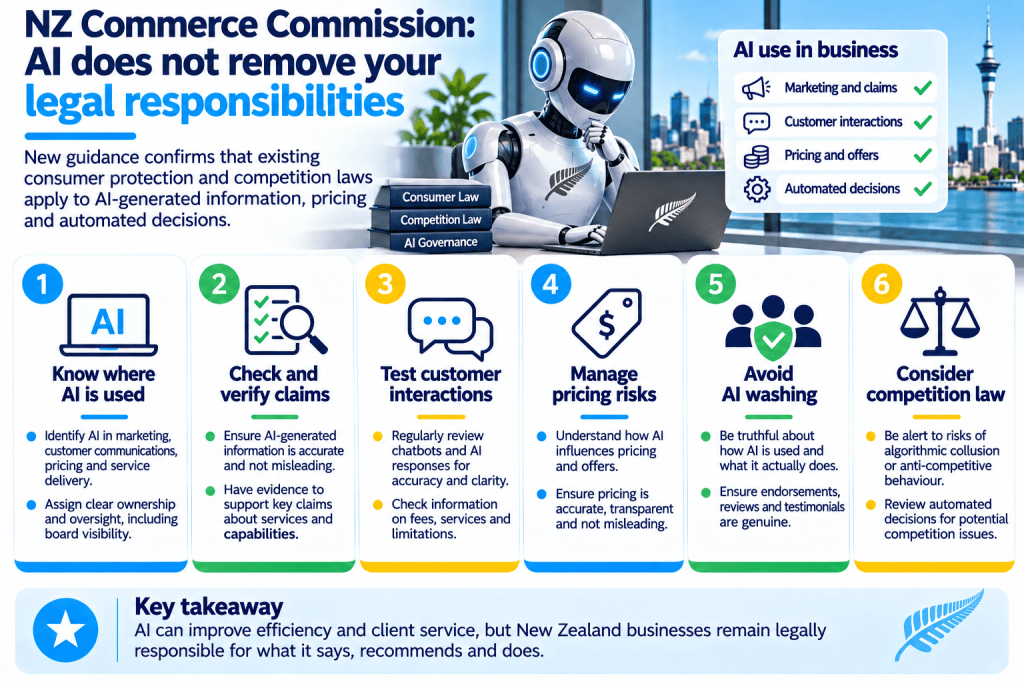
- New Zealand’s Commerce Commission has issued specific AI guidance for businesses. Existing consumer protection and competition laws apply whether decisions and communications are produced by employees, algorithms or AI systems.
- AI-generated claims, customer communications and automated pricing create compliance risks. Businesses need to check that information is accurate, claims can be substantiated and automated commercial decisions do not breach competition law.
- Professional services firms should extend AI governance beyond privacy and security. Marketing, client communications, recommendations, pricing and automated workflows all need appropriate oversight, testing and accountability.
On 18 November 2026, New Zealand’s Commerce Commission released new guidance explaining how businesses must comply with existing consumer protection and competition laws when using artificial intelligence. The guidance covers AI-generated information, customer interactions, marketing, pricing and automated commercial decisions. It also addresses risks such as misleading claims, fake endorsements, personalised offers and algorithmic collusion. The Commission’s message is clear: AI may change how businesses operate, but it does not change their legal responsibilities.
For New Zealand professional services firms, this is an important development because AI governance must now be considered alongside everyday commercial activities, not just technology, privacy and cyber security.
Existing laws apply to AI-generated decisions
The Commission’s guidance focuses primarily on two existing laws: the Fair Trading Act 1986 and the Commerce Act 1986. The Fair Trading Act prohibits misleading and deceptive conduct and regulates certain unfair commercial practices. The Commerce Act addresses anti-competitive behaviour, including cartel conduct and misuse of market power.
Neither law requires a separate AI-specific breach before enforcement action can be considered. The relevant question is whether the business’s conduct complies with the law, regardless of which technology was used. The Commission has also clarified that it does not regulate AI technology itself. Its role is to enforce competition and consumer protection laws where AI contributes to conduct that may breach those laws.
This distinction matters. The guidance does not introduce a new AI licensing regime or additional legislation, but it makes existing compliance expectations more explicit.
AI-generated information must be accurate and supportable
One of the most immediate risks for professional services firms involves AI-generated content. Generative AI can produce convincing descriptions of services, marketing material, customer responses and recommendations. However, its ability to produce fluent language does not guarantee that the underlying information is correct. The Commission warns that businesses may be responsible where AI-generated advertising, website content or chatbot responses mislead consumers.
It also highlights the requirement to have reasonable grounds for claims about products and services. AI-generated statements alone do not provide sufficient evidence that a claim is true. For example, an accounting firm using AI to draft promotional material should verify claims about its expertise, services and results. A consultancy describing its capabilities as AI-powered should be able to substantiate what that technology actually does.
The same principle applies to customer-facing AI assistants. If a chatbot provides incorrect information about fees, service limitations or contractual arrangements, the business cannot simply attribute the mistake to the technology.
AI washing and fabricated endorsements
The Commission has specifically identified AI washing as a compliance risk. AI washing occurs when businesses exaggerate or misrepresent their use of artificial intelligence, including claiming that products or services have AI capabilities they do not genuinely possess. This is particularly relevant as organisations increasingly promote AI-enabled services to differentiate themselves from competitors. A firm describing a service as AI-powered should be able to explain what AI contributes and avoid creating misleading impressions about automation, accuracy or capability.
The guidance also addresses fabricated endorsements, reviews and testimonials. AI can generate convincing images, audio and written statements that appear to represent genuine customer experiences or professional endorsements. Publishing fabricated material of this kind may breach the Fair Trading Act.
Professional services firms should therefore ensure that testimonials, client success stories and endorsements reflect genuine experiences and are appropriately authorised.
Personalised pricing introduces additional risks
AI is increasingly capable of analysing customer information and recommending different prices, discounts or service arrangements. Personalised pricing is not automatically unlawful. However, the Commission warns that businesses must ensure these practices are accurate, transparent where necessary and not misleading. For example, an AI system might recommend different service packages based on a customer’s circumstances, purchasing history or predicted willingness to pay. The governance concern is whether customers receive misleading information about pricing, available alternatives or the basis of an offer.
For professional services firms, this means automated fee estimates, proposals and service recommendations should be reviewed for accuracy and consistency with the firm’s commercial policies. Where AI influences pricing, organisations should understand what information the system uses and whether its recommendations create legal or reputational risks.
Competition law applies to automated decisions
The Commerce Commission’s guidance also addresses a less familiar issue: the potential for AI systems to contribute to anti-competitive conduct. Businesses increasingly use algorithms to monitor competitors, analyse markets and adjust prices. These tools can improve efficiency, but they may also create competition law risks.
The Commission warns that businesses remain responsible if AI systems facilitate cartel conduct or other behaviour prohibited by the Commerce Act. For example, automated pricing systems could be used to coordinate prices between competitors or support arrangements that reduce competition.
The guidance also considers risks involving businesses with substantial market power, including self-preferencing, tying products together and exclusionary pricing practices. These issues may be particularly relevant to larger technology platforms and businesses using sophisticated automated pricing systems. However, professional services firms should also consider competition law when adopting shared pricing tools or AI systems that influence commercial decisions. Using the same technology provider as a competitor is not itself evidence of unlawful coordination. The concern is whether the resulting conduct breaches competition law.
Boards need visibility beyond technology teams
The Commission is encouraging boards and senior leaders to treat AI as a governance issue. Organisations should understand where AI is used, how it influences decisions, what information it produces and whether appropriate safeguards are operating. This requires involvement beyond IT departments. Marketing, sales, legal, compliance, finance and operational teams may all be responsible for activities affected by AI.
For professional services firms, the practical implication is that AI governance should cover the full client relationship, from advertising and initial enquiries through to recommendations, service delivery and billing. A firm may have strong controls protecting confidential client information while still overlooking misleading AI-generated marketing or inaccurate automated customer responses. Effective governance therefore needs to address both the information entering AI systems and the commercial outcomes they produce.
What this means for your organisation
1. Review customer-facing AI use. Identify where AI contributes to websites, marketing, proposals, chatbots, client communications and service recommendations. Confirm who is responsible for reviewing the resulting information.
2. Verify commercial claims. Check AI-generated statements about qualifications, capabilities, performance, pricing and service benefits. Maintain evidence supporting material claims rather than relying on AI-generated content as proof.
3. Test automated customer interactions. Regularly assess whether chatbots and other AI systems provide accurate information about fees, services, limitations and contractual arrangements. Include realistic questions and unusual scenarios.
4. Examine AI-assisted pricing. Understand how automated pricing or recommendation systems operate, what information they use and whether they could create misleading outcomes or competition concerns.
5. Review AI-related marketing. Ensure claims about AI capabilities are accurate and that endorsements, testimonials and customer reviews are genuine. Avoid exaggerating the role AI plays in delivering professional services.
6. Include consumer and competition law in AI governance. Extend existing AI risk assessments and staff training to cover Fair Trading Act and Commerce Act obligations where relevant.
7. Maintain evidence of oversight. Record appropriate testing, approvals, identified problems and corrective actions. Review controls when AI tools, workflows or commercial practices change.
These measures should be proportionate to the organisation’s activities. A small advisory practice using AI to prepare draft marketing material will have different risks from a large organisation using automated systems to determine customer prices.
A practical shift in New Zealand AI governance
The Commerce Commission’s guidance represents an important development in New Zealand’s approach to AI. Rather than introducing a separate set of AI-specific rules, the regulator is explaining how established legal obligations apply as businesses adopt new technology.
For professional services firms, the lesson is that AI governance cannot stop at protecting confidential information or requiring human review of generated content. Organisations also need confidence that AI-assisted communications are accurate, commercial claims are supportable and automated decisions comply with existing law.
As AI becomes more deeply integrated into everyday business activities, effective governance will depend on understanding not only how the technology operates, but also what it communicates, recommends and does on the organisation’s behalf.
Sources
- New Zealand Commerce Commission, Commerce Commission issues AI guidance for New Zealand businesses, 18 November 2026
- New Zealand Commerce Commission, AI and the Fair Trading Act
- New Zealand Commerce Commission, AI and the Commerce Act
- New Zealand Commerce Commission, Algorithmic Collusion and the Commerce Act