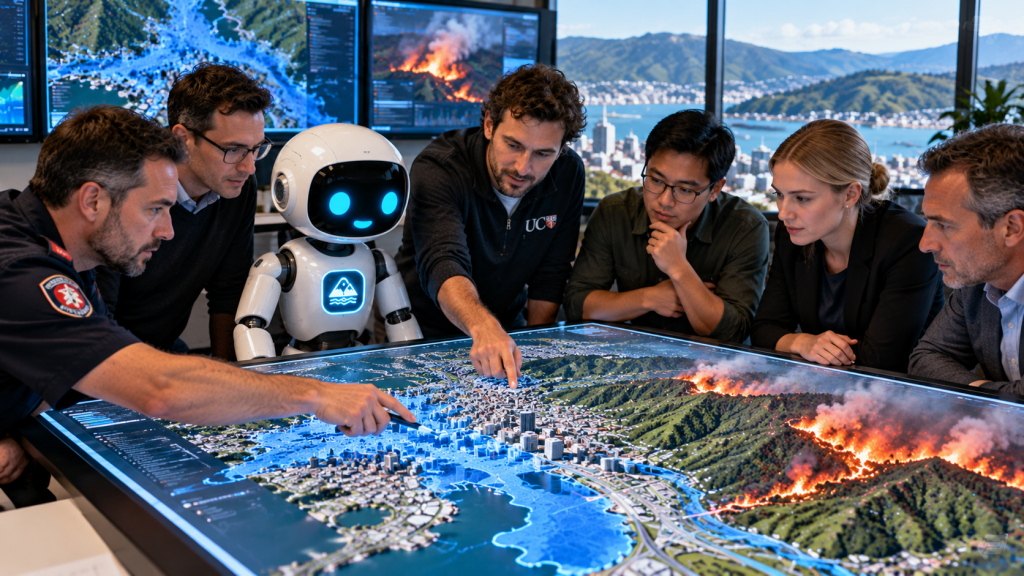
University of Canterbury researchers are using artificial intelligence and digital simulations to help Wellington prepare for future flooding, wildfires and extreme weather. The research combines detailed computer models of natural hazards with information about how people travel through the city, allowing researchers to explore the potential consequences of disasters before they occur.
The work forms part of an international research initiative called Minority Report, funded through the European Union’s Horizon Europe programme. Wellington is one of three case-study cities, alongside Dublin in Ireland and Patras in Greece. The project aims to help councils, emergency services and infrastructure operators make better decisions about disaster preparedness and climate resilience.
Key facts
- University of Canterbury researchers are leading the Wellington modelling of flood risks, wildfires and human mobility.
- The team is developing a digital twin of Wellington to simulate natural hazards and their consequences.
- AI is being used to model how wildfires spread and to support the forecasting of heavy rainfall impacts.
- Flood simulations examine disruption to roads, hospital access, school journeys and other essential travel.
- Wellington City Council, Fire and Emergency New Zealand and Tiaki Wai are among the organisations involved.
- The international project has approximately NZ$9.3 million in funding and is scheduled to continue until November 2027.
Our take
This is an excellent example of New Zealand researchers applying AI to a practical challenge with potentially significant benefits for communities. Rather than simply predicting that a flood or wildfire might occur, the technology could help decision-makers understand the consequences, including which roads become inaccessible, how emergency services are affected and where preventative investment could make the greatest difference.
For New Zealand councils, infrastructure providers and emergency management organisations, this type of modelling could improve resilience planning and resource allocation. Importantly, the technology is intended to support human decision-making, not replace it. Its value will depend on reliable data, transparent assumptions, rigorous testing and the ability to turn research findings into practical action.

