Key takeaways
- New international guidance published by New Zealand’s National Cyber Security Centre (NCSC) highlights the financial, security and operational risks associated with AI token consumption.
- Excessive AI usage, whether accidental or malicious, can cause unexpected costs, degraded performance and disruption to essential services.
- Organisations should introduce consumption monitoring, usage limits and resilience planning, particularly as autonomous AI agents become more widely adopted.
New Zealand’s NCSC has published international guidance addressing an emerging challenge for organisations adopting artificial intelligence: managing AI consumption and its impact on costs, security and operational resilience.
Developed alongside cyber security agencies from Australia, Canada, the United Kingdom and United States, Managing AI Token Consumption for Operational Resilience reinforces that AI governance must extend beyond privacy and security to include financial management and service availability.
Understanding the hidden costs of AI
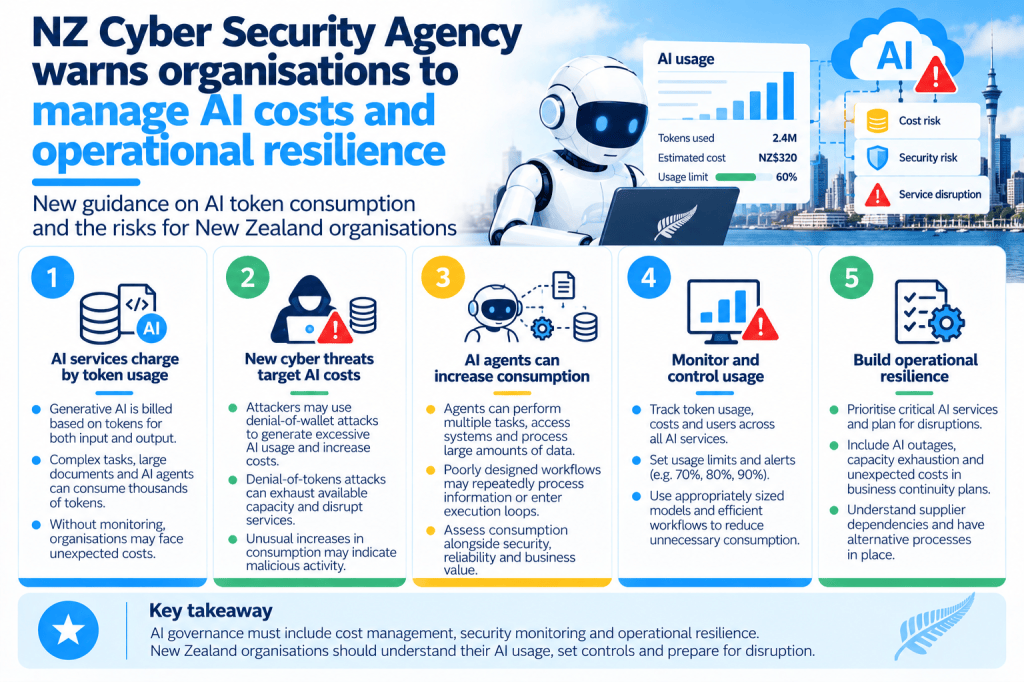
Unlike traditional software subscriptions, many AI services charge according to consumption, measured in units known as tokens. Both information submitted to a model and its responses can contribute to usage charges.
Complex activities involving large documents, extended conversations and connected applications can consume substantial numbers of tokens. Autonomous AI agents can increase consumption further by performing multiple tasks without continuous human involvement.
Without appropriate monitoring, organisations may face unpredictable costs and unexpected pressure on available AI capacity.
Denial-of-wallet attacks introduce new risks
The guidance highlights two emerging threats: denial-of-wallet and denial-of-tokens attacks.
A denial-of-wallet attack deliberately generates excessive AI usage to impose financial costs. A denial-of-tokens attack attempts to exhaust available capacity or usage limits, potentially preventing legitimate users from accessing AI services.
Attackers may exploit automated workflows, submit repeated complex requests or manipulate agents into unnecessary processing. The consequences can include unexpected expenditure, slower responses and disruption to business operations.
Unusual increases in AI consumption should therefore be considered potential security indicators, not simply financial anomalies.
Why AI agents increase the challenge
AI agents introduce additional complexity because they can retrieve information, interact with applications and complete extended workflows.
An agent reviewing client information might retrieve records, analyse documents and generate reports, with each activity consuming additional tokens. Poorly configured agents may repeatedly process information or enter execution loops, increasing costs without producing useful results.
Organisations need to assess consumption alongside security, reliability and business value when deploying agentic AI.
Five practical AI governance measures
1. Monitor AI consumption. Establish visibility over AI services, users, applications and agents. Track expenditure and consumption patterns, including automated processes operating outside normal business hours.
2. Introduce usage limits and alerts. Set consumption thresholds to identify abnormal activity before significant costs arise. The guidance illustrates escalating notifications at 70%, 80% and 90% of allocated usage, although these are examples rather than mandatory requirements.
3. Prioritise critical services. Identify AI applications supporting essential operations and determine how available capacity should be allocated during disruption. Cyber defence, incident response and other critical functions may require priority access.
4. Optimise models and workflows. Use appropriately sized models, efficient prompts, caching and workflow controls to reduce unnecessary consumption without compromising required performance.
5. Prepare for AI disruption. Include AI service outages, capacity exhaustion and unexpected costs in business continuity planning. Identify supplier dependencies, alternative processes and recovery arrangements.
Integrating AI consumption with security monitoring
The NCSC guidance also encourages organisations to integrate AI consumption data with existing cyber security monitoring. Correlating unusual token usage with authentication events, application activity and network traffic may help identify compromised accounts, unauthorised automation or abnormal agent behaviour.
Centralised AI gateways or proxies can provide additional visibility and help enforce consistent usage policies across multiple AI services.
For professional services firms handling confidential client information and increasingly relying on AI-enabled workflows, these controls can support both financial oversight and cyber security.
What this means for your organisation
AI consumption should become part of an organisation’s broader governance, risk management and operational resilience arrangements. Boards and executives should understand where AI is being used, what it costs, which services are business-critical and how unexpected consumption or service disruption could affect operations.
As AI agents become more capable and autonomous, organisations should establish clear ownership, spending limits, monitoring and safeguards against uncontrolled processing.
The objective is not simply to reduce expenditure. It is to ensure AI remains secure, affordable, reliable and available when needed.