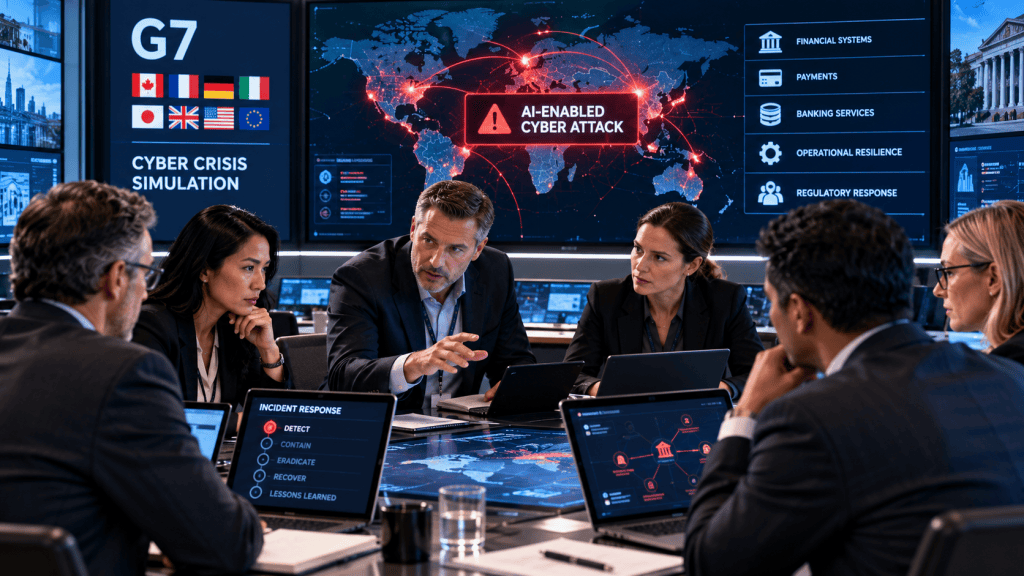
Finance ministers and central bank governors from the Group of Seven (G7) have agreed to conduct coordinated cyber crisis simulations examining the growing risks posed by advanced artificial intelligence. The initiative will test how financial authorities respond to AI-enabled cyber attacks that could disrupt banking systems and critical financial services.
The exercises will examine whether existing incident response procedures remain effective against increasingly sophisticated threats. Findings will be used to improve response protocols and strengthen coordination between financial regulators and potentially private financial institutions. The decision reflects growing international concern about the potential consequences of AI-enabled attacks on financial stability.
Key facts
- G7 finance leaders have approved coordinated tabletop exercises addressing frontier AI cyber risks.
- The simulations will examine responses to AI-enabled attacks affecting financial systems.
- Finance ministries and central banks will participate.
- Private financial institutions may also be involved.
- Exercise findings will inform improvements to existing response procedures.
- The initiative follows warnings about AI-enabled cyber attacks potentially undermining confidence in financial institutions.
Our take
This is a welcome development and reinforces the importance of practical cyber incident preparedness. As AI increases the speed and sophistication of cyber attacks, organisations need to understand whether their existing incident response arrangements remain effective. The G7 initiative also highlights the importance of testing coordination between organisations, regulators and critical service providers.
For New Zealand, the approach aligns with the recent emphasis from the Reserve Bank and Financial Markets Authority on preparing for AI-enabled cyber incidents. Having an incident response plan is important. Testing whether leadership teams can execute it under pressure is essential. Realistic crisis exercises remain one of the most effective ways to identify weaknesses before an actual incident occurs.

