Key takeaways
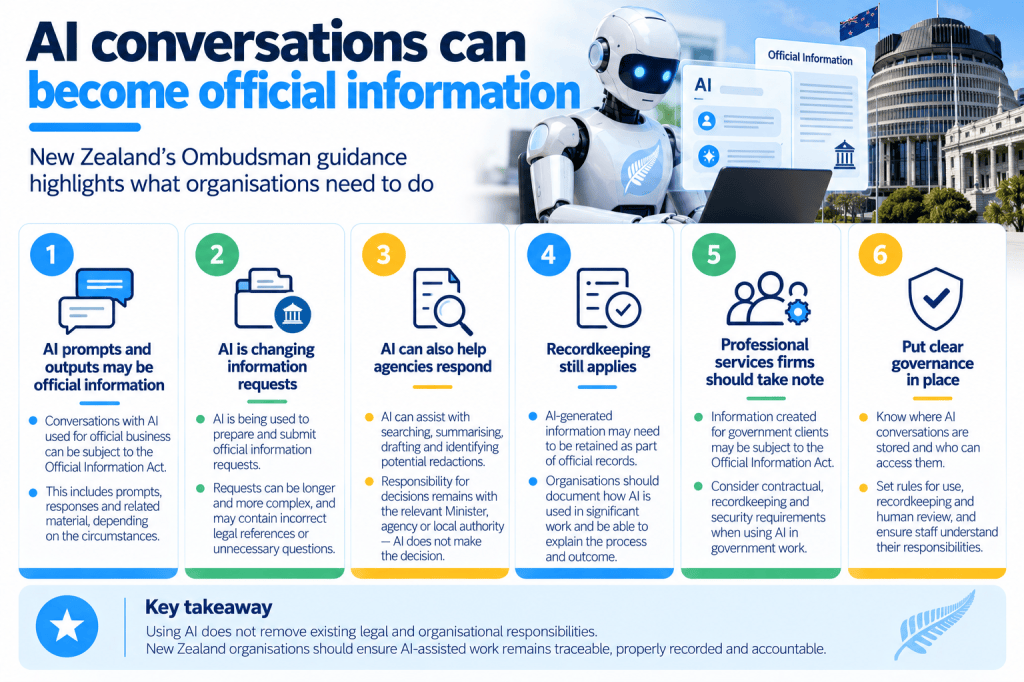
- AI prompts and outputs can become official information. New guidance from New Zealand’s Chief Ombudsman highlights why organisations need to consider how AI conversations are recorded, retained and managed.
- AI does not change existing accountability requirements. Government agencies remain responsible for decisions about official information, even when AI assists with searching, summarising, drafting or identifying potential redactions.
- Professional services firms need to consider their government-related work. AI records created while providing services to public agencies may have information-management and disclosure implications, depending on the circumstances.
On 6 October 2026, New Zealand’s Office of the Ombudsman released new guidance addressing the growing use of artificial intelligence in official information requests.
The guidance covers people making requests, public sector agencies responding to them and individuals submitting complaints. It also addresses a less obvious issue: what happens when AI itself creates information that may later be requested.
For New Zealand professional services firms, particularly those advising government agencies, councils and public sector organisations, the development raises practical questions about AI conversations, recordkeeping, transparency and accountability.
AI is changing both sides of official information requests
The Ombudsman reports that government agencies are experiencing a significant increase in requests prepared using AI. Its investigators are also receiving more complaints that appear to have been AI-generated. The problem is not simply the volume of requests. AI can produce lengthy, complex documents containing unnecessary questions, incorrect legal references or obligations that do not exist.
Chief Ombudsman John Allen has encouraged requesters to be clear and focused about the information they want. Requests that are unnecessarily broad or complicated can increase processing time and may, depending on the circumstances, be refused under existing legislative provisions.
AI can also help agencies respond more efficiently. Potential uses include identifying relevant records, summarising information, preparing draft responses and suggesting possible redactions. However, the guidance makes an important distinction between using AI to assist with a process and allowing AI to determine the outcome.
Responsibility for decisions remains with the relevant Minister, government agency or local authority.
Your AI conversations may themselves be official information
Perhaps the most significant governance implication concerns the information created when people use AI. An employee might ask an AI assistant to analyse policy options, summarise consultation submissions, prepare advice or compare alternative approaches. Those interactions may generate prompts, responses, revised instructions and other information that contributes to an organisation’s work.
Where that information is held in connection with official business, it may fall within the scope of New Zealand’s official information legislation. This is not a completely new legal principle. The Official Information Act 1982 and Local Government Official Information and Meetings Act 1987 already govern access to information held by the public bodies within their scope.
What AI changes is the volume, location and format of potentially relevant information. An AI conversation might exist in an enterprise platform, an application connected to organisational systems or a personal AI account used for official work. The fact that information was generated through AI does not automatically place it outside existing information-access requirements.
Equally, not every AI prompt must be retained indefinitely or released on request. The circumstances, applicable recordkeeping obligations and lawful grounds for withholding information remain important.
Two new Ombudsman cases illustrate the complexity
Alongside the guidance, the Ombudsman published two case notes involving AI and official information.
One concerned a request for a parliamentary under-secretary’s conversations with generative AI tools, including interactions through personal or non-official accounts where the tools had been used for official purposes. The official provided a summary rather than the complete conversation histories, explaining that the volume of material and difficulty extracting the records created a substantial administrative burden. The Ombudsman’s case note addresses the circumstances in which providing a summary was appropriate.
A separate case concerned an AI-assisted policy paper prepared for the Minister of Finance. The requested material was withheld under an Official Information Act provision protecting the effective conduct of public affairs through the free and frank expression of opinions.
These cases demonstrate that AI-generated information is not automatically public or automatically confidential. The relevant questions concern what information is held, how it was used, the nature of the request and whether any lawful grounds justify withholding it or providing it in another form. For organisations, this reinforces the importance of being able to identify and explain AI-generated information when required.
Recordkeeping must extend beyond conventional documents
Archives New Zealand has already established that information created through AI can form part of public and local authority records. Its guidance explains that public sector organisations need to document how AI affects information and records, particularly where AI contributes to decisions or important business activities. This creates a practical challenge.
Traditional records management generally focuses on documents, correspondence, reports, decisions and structured business information. AI introduces conversational records that may contain several iterations of instructions, source material, intermediate outputs and revisions. The final document may not explain how the AI was used or what information influenced its preparation.
For significant AI-assisted work, organisations may therefore need to retain sufficient information to reconstruct the process. Depending on the circumstances, that could include the AI system used, relevant prompts and outputs, source information, human review and the resulting decision.
The objective should not be to preserve every routine AI interaction. It should be to ensure important business activities remain properly documented, understandable and accountable.
Why this matters for professional services firms
The Ombudsman’s guidance is primarily directed at public sector agencies and people interacting with the official information system. It does not make every private professional services firm subject to the Official Information Act. However, firms working with government clients need to consider the information they create and hold on those clients’ behalf.
Section 2(5) of the Official Information Act provides that information held by an independent contractor in that capacity is treated as information held by the relevant public agency, Minister or organisation. This can be relevant where consultants, lawyers, technology providers or other professional advisers create information while carrying out government work.
For example, a consultancy using AI to prepare advice for a government department may generate working material that contributes to its recommendations. Whether particular information is subject to disclosure will depend on the facts and applicable law, but the firm should not assume that using an external AI platform removes information from the official information framework.
There are also contractual considerations. Government clients may require suppliers to comply with specific information-management, security, confidentiality and recordkeeping obligations.
These requirements should be considered before AI is introduced into client workflows, rather than after an information request or dispute arises.
What this means for your organisation
1. Review how AI conversations are stored. Identify which approved AI platforms retain prompts and responses, where those records are located, who can access them and whether they can be exported when legitimately required.
2. Establish proportionate recordkeeping rules. Determine which AI-assisted activities require supporting records. Focus particularly on advice, decisions, investigations, assessments and other significant professional work.
3. Review government-client arrangements. Where your organisation provides services to public agencies, check contractual and statutory requirements relating to information creation, retention, retrieval and disclosure.
4. Maintain human review of AI-generated material. Ensure staff verify legal references, factual claims, summaries and proposed redactions before using AI-generated content in formal advice or official information responses.
5. Record meaningful AI involvement. For higher-risk work, retain enough information to explain the AI system used, its contribution, the checks undertaken and who approved the final result.
6. Consider information retrieval during procurement. Before adopting an AI platform, establish whether relevant conversation histories and supporting records can be accessed, exported and managed consistently with organisational requirements.
7. Update staff guidance. Make employees aware that AI conversations used for official business may have recordkeeping and disclosure implications, including when personal accounts are used.
AI governance now includes information governance
The Ombudsman’s new guidance reinforces a familiar principle: adopting new technology does not remove existing legal and organisational responsibilities. AI can make information easier to create, analyse and summarise. It can also make information harder to locate, interpret and manage when records are spread across conversational systems and external platforms.
For New Zealand organisations, the practical challenge is ensuring that important AI-assisted work remains traceable and accountable. That requires more than an acceptable-use policy. It requires appropriate recordkeeping, reliable access to information, clear ownership and human responsibility for decisions.
As AI becomes embedded in everyday professional work, the ability to explain what information was created, how it was used and why a decision was made will become an increasingly important part of effective AI governance.
Sources
- Office of the Ombudsman, New guidance on official information and the use of AI, 6 October 2026
- Office of the Ombudsman, Advice for agencies on information requests and AI, 6 October 2026
- Office of the Ombudsman, Agency could provide summary of AI chat logs, 6 October 2026
- Archives New Zealand, Artificial intelligence and public and local authority records
- New Zealand Legislation, Official Information Act 1982, particularly section 2(5)