Key takeaways
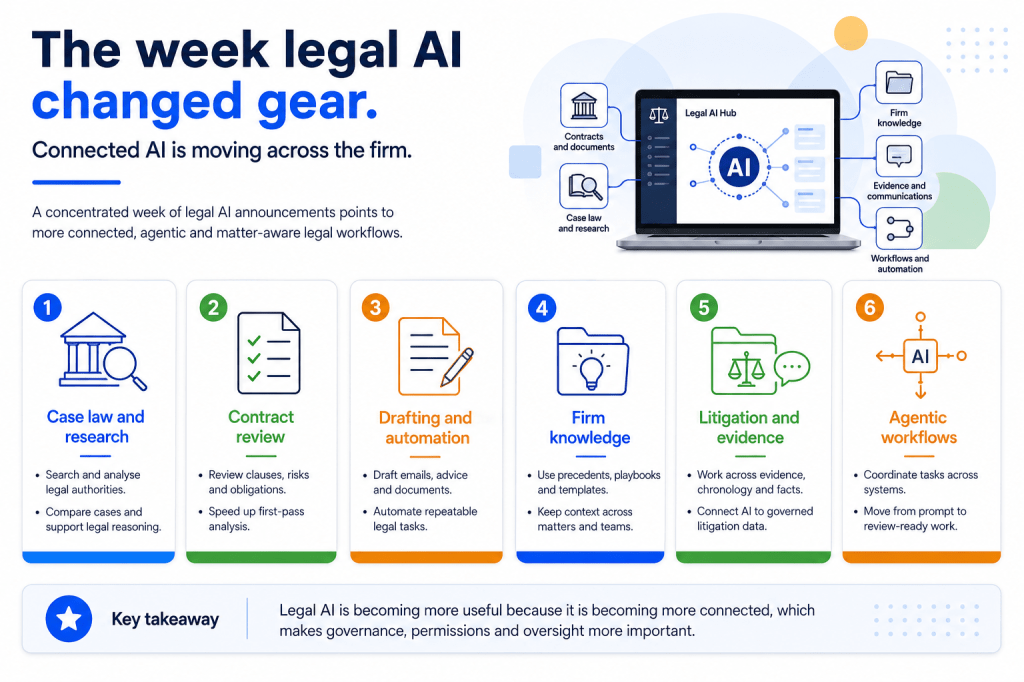
- In a single week, Thomson Reuters, LexisNexis, Google, Clio, Everlaw and Harvey announced significant developments in legal AI.
- The common theme is a shift away from standalone AI assistants towards connected, agentic and matter-aware platforms that can work across research, documents, evidence and firm knowledge.
- For New Zealand law firms, the strategic question is increasingly which AI platforms will become part of the firm’s core technology environment, how they will connect to existing systems, and how that access will be governed.
The last week of August produced an unusually concentrated series of legal AI announcements. Individually, each development is interesting, but together they point to a more significant change in direction for legal technology.
Thomson Reuters launched its own legal model and expanded CoCounsel, LexisNexis pushed Protégé further into agentic workflows, Google entered the sector more directly with Gemini Enterprise for Legal, Clio expanded Vincent, Everlaw announced integrations with several leading AI platforms, and Harvey continued extending both its capabilities and firm-wide adoption.
The common theme is clear: legal AI is moving from individual tools towards an interconnected technology layer for legal work.
Thomson Reuters builds its own legal model
One of the week’s most significant developments was Thomson Reuters launching Thomson, its first proprietary large language model. Rather than building a general-purpose frontier model from the ground up, Thomson Reuters has specialised an open-source foundation using its legal, tax and professional information assets.
The importance is less about another model entering the market and more about control. Thomson Reuters can now exercise greater influence over the cost, development, specialisation and integration of the AI underpinning parts of its legal environment, while differentiating itself through its proprietary content.
At the same time, the next generation of CoCounsel Legal expands research, drafting, verification and matter-focused workflows. This includes working across larger document sets and checking whether cited authorities actually support propositions made in legal work.
LexisNexis moves further towards agentic legal work
LexisNexis also expanded Lexis+ with Protégé, moving towards workflows where a lawyer describes the required outcome and the platform coordinates the appropriate models, agents, skills and information sources behind the scenes.
This represents an important transition from the early legal AI experience. Instead of separately asking an AI to research an issue, summarise documents and then draft something, the platform increasingly manages those steps as part of one connected workflow.
The lawyer still reviews and takes responsibility for the work, but the technology is beginning to manage more of the process between the initial instruction and the proposed final product.
Google enters legal AI more directly
Google’s announcement of Gemini Enterprise for Legal may have some of the broadest long-term implications. The platform is designed specifically for law firms and corporate legal teams, combining reusable legal capabilities, connections to firm systems, AI agents and specialist legal technology.
Google’s approach reinforces an important point: a capable foundation model alone is unlikely to be enough for sophisticated legal work. Much of the value comes from connecting AI to a firm’s documents, playbooks, matter systems, permissions and specialist applications.
That changes the competitive landscape. The question is no longer simply which company offers the best legal chatbot, but which platform becomes the environment through which lawyers access their knowledge, systems and AI capabilities.
For law firms already operating heavily within Microsoft or Google environments, these broader technology ecosystems may increasingly influence decisions that previously sat mainly within specialist legal technology.
Legal AI is moving closer to the evidence
Everlaw’s announcements during the week illustrate another part of this transition. The litigation and investigation platform announced integrations with Thomson Reuters CoCounsel Legal, Harvey, Google Gemini Enterprise for Legal and Microsoft 365 Copilot.
The idea is that lawyers can work through their preferred AI environment while Everlaw remains the governed evidence layer underneath it, retaining control over the underlying documents, permissions and audit information.
This matters because legal analysis often depends on much more than legislation and reported decisions. Litigation and investigations can involve millions of emails, documents, messages, witness materials and other evidence where context, provenance and access controls are critical.
Rather than one AI platform replacing everything else, the emerging model may therefore involve several specialised systems securely connecting with each other.
Clio is looking beyond the law firm
Clio also extended Vincent during the week, including the announcement of Docket Insights, giving the platform access to a very large collection of US court records. The objective is to allow conventional legal research to be considered alongside filings, procedural histories and other court information.
Clio also appointed Casetext co-founder Pablo Arredondo to lead its judiciary work, signalling an intention to expand AI beyond law firms and into courts and justice institutions.
That development remains at an early stage, but it is worth watching. Legal AI has largely developed on the lawyer’s side of the justice system, whereas greater adoption within courts could eventually influence how matters are filed, analysed, managed and accessed.
Harvey becomes more persistent and embedded
Harvey’s developments followed a related theme: making legal AI more personalised and persistent. Its new Memory capability allows preferences and context to carry between interactions rather than requiring users to repeatedly explain how they want work approached.
That is a relatively simple concept, but it matters as AI becomes embedded in longer-running matters and projects. The value of legal AI increases when it understands how a lawyer or firm works, but so do questions about what information it retains, how that information is governed and where boundaries sit between clients and matters.
Harvey also continued its rapid firm-wide adoption, reinforcing the broader shift from selected pilots towards AI being available as part of everyday legal practice.
The bigger development: legal AI is becoming infrastructure
The common thread through these announcements is context and connection. Legal AI is being linked to legal research, precedents, client documents, matter information, evidence, court records and organisational knowledge, while agents increasingly coordinate work across those sources.
That should make the technology considerably more useful, but it also increases the governance consequences. An AI system that drafts a paragraph can operate with narrow access, whereas an agent able to search document management systems, retrieve matter information, examine evidence and invoke multiple tools requires much stronger control over permissions and information boundaries.
The technology is becoming more capable precisely because it is becoming more connected.
What this means for New Zealand law firms
Think beyond individual AI products. Consider where AI will sit within the firm’s wider technology architecture and which systems, documents and information repositories it may eventually access.
Protect matter boundaries. AI integrations need to respect ethical walls, client confidentiality, information barriers and existing matter permissions.
Understand agent permissions. As platforms become more agentic, define what they may retrieve, create, change or action without additional human approval.
Plan for interoperability. The future legal technology environment may involve several specialised platforms working together rather than one system performing every function.
Preserve professional oversight. More sophisticated workflows do not change the lawyer’s responsibility for the quality and appropriateness of the final legal work.
Look beyond features when selecting vendors. Data governance, integration, portability, auditability, security and the supplier’s likely long-term role should form part of the assessment.
A significant week for legal AI
No single announcement last week transformed legal practice. What made the week significant was the pattern across almost every major development.
Legal information companies are building their own models, general technology companies are developing dedicated legal platforms, specialist providers are becoming increasingly agentic, and legal systems are being connected to each other rather than operating independently.
The first phase of legal AI asked whether AI could research, summarise and draft. The emerging phase is about whether AI can understand the wider context of a matter and work securely across the systems lawyers already use.
For New Zealand firms, that may ultimately make architecture, access, governance and professional oversight as important as which model produces the best answer.
Sources
- Thomson Reuters, launch of proprietary model “Thomson”, August 2026
- LexisNexis, new agentic capabilities in Lexis+ with Protégé
- Google Cloud, Introducing Gemini Enterprise for Legal
- Clio, Pablo Arredondo joins Clio to lead judiciary expansion
- Everlaw, legal AI partnerships and integrations
- Harvey, product announcements and developments