
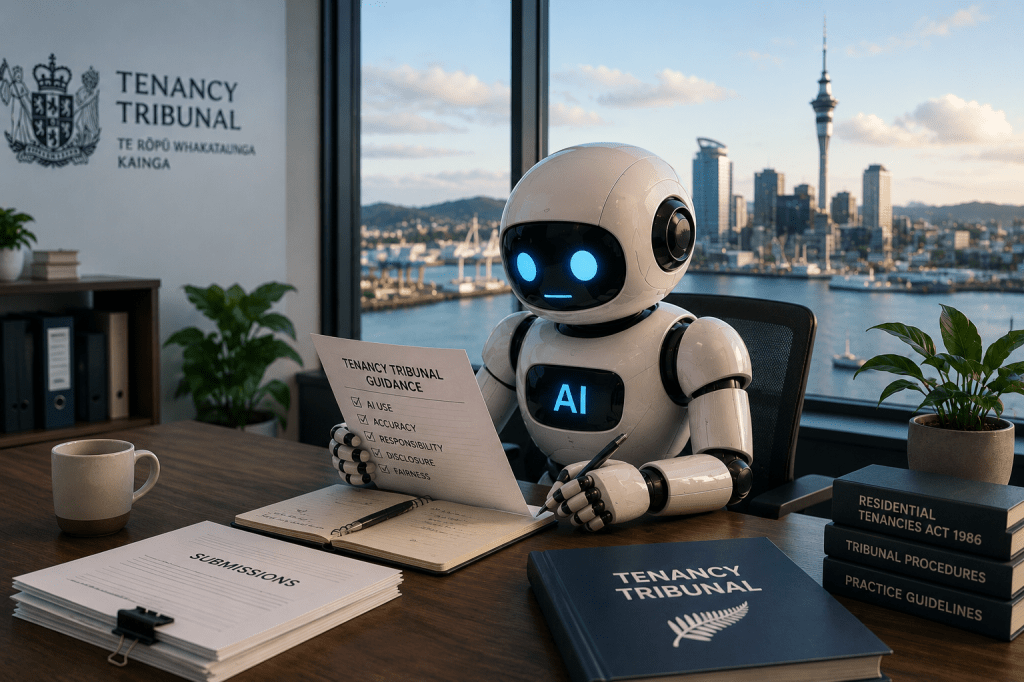
New Zealand’s Tenancy Tribunal has issued specific guidance for people using generative AI to prepare cases, submissions, evidence and other material. The Tribunal recognises that AI can improve access to justice by helping people understand legal issues, organise documents and prepare for hearings, particularly where they do not have a lawyer.
At the same time, the Tribunal is seeing practical problems from AI use, including inaccurate legal information and unnecessarily large volumes of material. The guidance warns that AI can invent cases or legal principles, misstate facts, produce unreliable witness statements and generate convincing but false images, audio or video. It also specifically identifies AI “overproduction”, where simple claims become unnecessarily long, repetitive and complex.
Key facts
- Parties remain responsible for everything they submit, even where AI helped produce it. Saying that the AI made a mistake is not an excuse.
- AI-generated material should be independently checked, including legal authorities and factual claims. The guidance specifically says not to rely on another AI tool to perform that verification.
- Excessive or irrelevant AI-generated material can delay proceedings and, in serious cases, contribute to costs orders or claims being struck out.
- Parties must disclose their use of AI if the Tribunal asks.
- AI must not be used to record, transcribe, summarise or analyse Tribunal hearings or mediation discussions.
Our take
The guidance takes a practical approach rather than discouraging AI altogether. It recognises that generative AI can make legal processes more accessible, while making clear that efficiency does not outweigh accuracy, relevance, privacy or personal responsibility.
The same principle applies beyond the Tribunal. New Zealand organisations, particularly legal and professional services firms, should ensure staff understand that using AI to prepare work does not transfer responsibility to the tool. AI-generated work should be checked by an appropriately skilled person, confidential information should be protected, and producing more material should not be mistaken for producing better work.

