Three key takeaways
- Specialist legal AI tools are not interchangeable. Some focus on authoritative legal research, others on document analysis, drafting, contracts, firm knowledge or practice management.
- Several major platforms are now available in New Zealand, but the depth of New Zealand legal content, local implementation evidence and data arrangements varies considerably.
- Firms should select a tool for a defined legal workflow and test its accuracy, security and commercial value before approving wider use.
Specialist legal AI is moving beyond experimentation in New Zealand.
Publicly reported examples include a large national firm deploying Harvey to more than 200 lawyers, a mid-sized full-service firm adopting the same platform under formal governance controls, and a commercial firm implementing Vincent across multiple practice areas. Smaller practices and in-house teams are also using publisher-backed or practice-management-based tools.
The expanding range of products creates a new problem: choosing between platforms that may look similar in a demonstration but have materially different legal sources, capabilities, integrations and risk profiles.
The right question is no longer simply whether a law firm should use AI. It is which type of specialist AI is suitable for the firm’s work, clients and information.
The main categories of specialist legal AI
Most specialist legal AI products fall into one or more of four categories.
Enterprise legal workspaces such as Harvey and Legora support a broad range of work, including research, drafting, document analysis, due diligence, knowledge retrieval and multi-stage workflows.
Publisher-backed platforms such as Thomson Reuters CoCounsel and Westlaw New Zealand, Lexis+ with Protégé, formerly known as Lexis+ AI, and Vincent combine generative AI with established legal databases.
Transactional drafting tools such as Spellbook concentrate on contracts, clauses, redlining, playbooks and drafting within Microsoft Word.
Practice-management and legal-operations platforms such as LEAP with LawY and LawVu LegalOS place AI within a broader environment for managing matters, documents, contracts, intake and legal workflows.
These categories increasingly overlap. However, the distinction remains useful because the strongest tool for contract negotiation may not be the strongest tool for New Zealand case-law research or the best fit for an existing practice-management system.
Harvey and Legora: broad legal workspaces
Harvey has become one of the most visible enterprise legal AI platforms.
It supports legal research, drafting, document analysis, due diligence and knowledge-based workflows. It can also connect with systems such as Microsoft Word, Outlook, SharePoint, iManage and NetDocuments.
Harvey introduced a New Zealand Wolters Kluwer Knowledge Source in April 2026. This provides access to New Zealand legislation, case law, regulatory materials and other local legal content across several practice areas.
There is also clear evidence of local adoption. One large New Zealand firm has deployed Harvey to more than 200 lawyers, while a full-service firm has publicly described adopting it under governance, confidentiality and human-review controls.
Legora occupies a similar broad category. It provides research, drafting, document analysis, precedent use and multi-stage legal workflows. Its materials also describe connections with firm documents, knowledge systems and other legal content.
Legora is available in New Zealand, and New Zealand firms were represented in a recent Legora study involving 31 participating law firms. However, the public customer materials reviewed for this article did not identify a named New Zealand firm using the platform.
This does not mean local firms are not using Legora. It means that public evidence of a specific New Zealand implementation is presently less visible than it is for Harvey and some other platforms.
A New Zealand firm considering either platform should test more than the quality of a demonstration. It should ask:
- Which New Zealand legal sources are available?
- Can answers be traced back to the original source?
- Can the system securely use the firm’s precedents and matter documents?
- Where are prompts, documents and outputs stored and processed?
- Which integrations are available in production rather than merely planned?
- How are user access, ethical walls, retention and deletion managed?
Enterprise workspaces are most likely to justify their cost where a firm has enough recurring, document-heavy work to support implementation, training and integration.
CoCounsel, Protégé and Vincent: AI connected to legal content
Legal research remains one of the areas in which specialist platforms can offer an important advantage over general-purpose AI.
A polished answer is not enough. A lawyer needs to know which law was used, whether it is current, whether it applies in New Zealand and whether the cited proposition is supported by the underlying authority.
Thomson Reuters introduced CoCounsel in New Zealand in March 2025. CoCounsel supports document review, comparison, summarisation, chronology preparation, drafting and knowledge-based workflows.
Westlaw New Zealand introduced AI-Assisted Research in October 2025. Its answers are linked to underlying legal sources, allowing lawyers to review the primary-law passages supporting the response.
Lexis+ with Protégé, formerly known as Lexis+ AI, combines generative AI with LexisNexis legal content, practical guidance and drafting capabilities. It can assist with New Zealand legal research, document analysis, summarisation and source-linked answers. Its Vault capability also allows authorised users to work with selected firm documents and internal materials.
Publicly available New Zealand examples include use by small practices, independent lawyers and an in-house legal team. This may make Protégé relevant to firms that want specialist research capabilities without implementing a larger enterprise workspace.
Vincent, provided by vLex, combines legal research with document analysis and configurable workflows. vLex maintains an extensive collection of New Zealand decisions, legislation, tribunal material and other legal sources.
Several New Zealand firms have publicly reported testing or implementing Vincent. Its broad international coverage may be particularly useful for firms working across New Zealand and overseas jurisdictions.
These products reduce some of the risks associated with asking a general chatbot to conduct legal research. They do not remove the lawyer’s obligation to check the result.
LawY and LEAP: AI within practice management
LawY is integrated with LEAP and is available to New Zealand LEAP customers as part of the wider platform.
It can assist with legal questions, summaries and drafting. It also offers an optional service through which research can be submitted for verification by qualified lawyers.
That distinction is important. LawY offers optional human verification, but firms should not assume that every immediate AI-generated answer has already been reviewed by a New Zealand lawyer.
Its principal advantage is integration. A firm already using LEAP may be able to introduce AI without implementing an entirely separate enterprise platform or moving information between multiple systems.
The corresponding limitation is that this advantage is strongest for existing LEAP customers. A firm using another practice-management system would need to compare the benefit of LawY with the cost and disruption of changing its wider technology environment.
Spellbook: contract drafting with limited New Zealand research coverage
Spellbook is primarily designed for contract drafting, review and negotiation within Microsoft Word.
It can help lawyers:
- draft or revise clauses;
- identify contractual issues;
- compare documents with a playbook;
- propose redlines;
- answer questions about a contract; and
- work across multiple transactional documents.
This makes it potentially useful for commercial firms, contract-heavy boutiques and in-house teams.
Spellbook now includes a citation-supported Legal Sources feature. It allows users to research selected public legal sources and provides citations to the material supporting an answer.
However, its published source list does not currently show the dedicated New Zealand legal coverage offered by platforms such as Protégé, Westlaw New Zealand, Harvey or Vincent. The listed international sources include AustLII and several overseas legal information institutes, but not a dedicated New Zealand legislation or case-law source.
Spellbook should therefore be assessed primarily as a contract drafting and review platform rather than as a comprehensive replacement for a specialist New Zealand legal research service.
LawVu LegalOS: AI for in-house legal operations
LawVu is a New Zealand-founded legal technology company focused primarily on in-house legal teams.
In June 2026, it launched LegalOS, an environment intended to connect legal intake, matters, contracts, documents, spend, reporting and AI-assisted workflows.
LegalOS includes an AI assistant, drafting capabilities, AI-supported intake and tools for constructing multi-step legal workflows. Its focus is not simply answering legal questions. It is coordinating work across the legal department’s operational systems and information.
This may make it relevant to in-house teams that want AI embedded across contract, matter and intake processes rather than purchasing an isolated research chatbot.
As with other platforms, capabilities described as agentic or autonomous should be assessed against actual controls. The legal team should establish which actions the system can take, what approvals are required, what is recorded in audit logs and how a lawyer can review or reverse an action.
How New Zealand firms are using specialist legal AI
Publicly reported implementations illustrate several different adoption patterns.
A large national firm has deployed an enterprise legal workspace to more than 200 lawyers. The implementation supports research, document handling and complex legal work within a controlled firm environment.
A mid-sized full-service firm has adopted the same platform while emphasising confidentiality, governance, human supervision and professional responsibility.
A large commercial firm has tested and integrated a research and workflow platform across several practice areas through a structured implementation programme.
Smaller firms have used publisher-backed tools to support research, document analysis and first drafts, allowing lawyers to direct more time towards strategy, judgement and client advice.
A regional practice has used an AI assistant integrated into its practice-management platform to summarise points of law and assist with drafting.
An in-house legal team has adopted a publisher-backed platform to improve internal legal research and the support it provides to the wider organisation.
These examples should not be treated as independent proof of the productivity claimed by a vendor. They show that local adoption is occurring across different types of legal practice, but the benefits will depend on the workflow, information, implementation and supervision involved.
Legal sources should be tested, not assumed
A platform may say that it supports New Zealand without providing comprehensive New Zealand legal research.
“Available in New Zealand” may mean that New Zealand customers can purchase the service. It does not necessarily mean the tool contains New Zealand legislation, case law, regulatory guidance, commentary or citator information.
Firms should require vendors to demonstrate the platform using real New Zealand legal questions.
A suitable evaluation set might include:
- a current statutory interpretation question;
- a question involving recent New Zealand case law;
- an issue requiring treatment of an amended or repealed provision;
- a question involving conflicting authorities;
- a problem requiring identification of an applicable regulation; and
- an issue for which overseas law differs materially from New Zealand law.
The firm should record incorrect citations, missed authorities, unsupported propositions and the amount of lawyer time required to check each answer.
Privacy, confidentiality and professional responsibility
Using a specialist legal platform does not transfer responsibility from the lawyer to the vendor.
The New Zealand Law Society’s guidance confirms that lawyers remain responsible for the accuracy and validity of material produced with AI. Lawyers must also protect confidentiality, privilege and personal information.
The Courts of New Zealand require lawyers to check AI-generated information and citations before using them in proceedings.
The Office of the Privacy Commissioner recommends completing a privacy impact assessment before using AI with personal information and reviewing that assessment as the system, information or proposed use changes.
A firm should examine:
- where prompts, source documents, outputs, logs and backups are stored;
- where each category of information is processed;
- whether vendor personnel can access information from other countries;
- which model providers and subprocessors receive information;
- whether information can be used for model training or product improvement;
- how long information is retained;
- how deletion is performed and verified;
- how security incidents will be reported; and
- what happens to the firm’s information when the contract ends.
A statement that information is hosted in Australia does not necessarily establish that all processing, support access and backups remain in Australia. These details should be confirmed contractually rather than inferred from general marketing material.
What this means for your firm
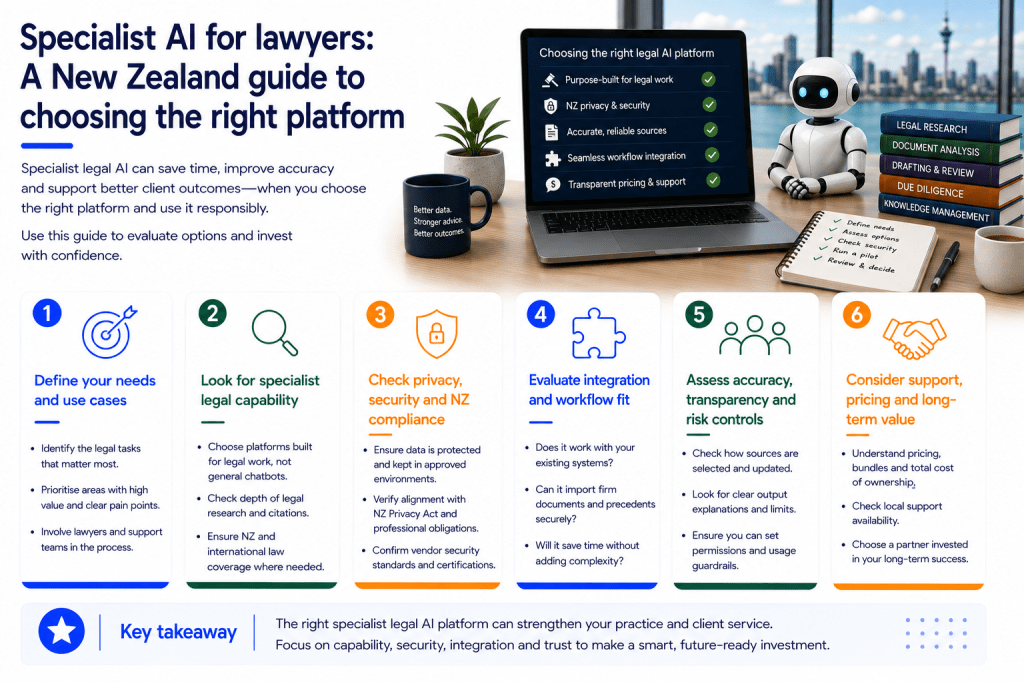
A firm considering specialist legal AI should take five practical steps.
1. Select one defined workflow
Begin with a specific problem, such as legal research, contract review, chronology preparation, due diligence or drafting from approved precedents.
2. Create a reliable benchmark
Test the platform using completed matters, confirmed authorities, approved memoranda, settled playbooks or documents with known issues.
3. Complete privacy and security due diligence
Review data flows, access controls, retention, subprocessors, model-provider arrangements, incident notification and termination provisions.
4. Require lawyer verification
Establish when source checking, supervisory review, client consent or disclosure of AI use is required. Prohibit users from treating AI output as final legal advice.
5. Measure realised value
Assess the complete workflow rather than relying on vendor claims about time savings. Relevant measures may include turnaround time, accuracy, supervision time, write-offs, fixed-fee margin, user adoption and the proportion of outputs that can actually be used after review.
Conclusion
Specialist legal AI is becoming a credible part of New Zealand legal practice, but there is no single platform that is best for every firm.
Harvey and Legora provide broad enterprise workspaces. CoCounsel, Westlaw New Zealand, Protégé and Vincent place greater emphasis on authoritative legal content. Spellbook concentrates on transactional drafting. LawY benefits from its connection with LEAP, while LawVu LegalOS is aimed at the broader operational needs of in-house teams.
The most important distinction is not between firms that use AI and firms that do not. It is between controlled use of a platform suited to the firm’s work and information, and adoption of a tool that produces impressive answers without fitting the way the firm is required to practise.
Sources
Replace the existing Sources section with the following:
Sources
Harvey
Legora
Thomson Reuters
- Thomson Reuters: CoCounsel introduced to New Zealand
- Thomson Reuters: Westlaw New Zealand AI-Assisted Research
- Thomson Reuters: Westlaw New Zealand features
- Thomson Reuters: CoCounsel for legal professionals
LexisNexis
- LexisNexis New Zealand: Protégé legal AI assistant
- LexisNexis New Zealand: Lexis+ legal research platform
Vincent and vLex
- vLex: Vincent AI
- vLex: New Zealand legal-content coverage
- vLex: Lewis Lawyers implementation of Vincent AI
LEAP and LawY
- LEAP New Zealand: LawY legal research assistant
- LEAP Help Centre: LawY availability, uses and optional lawyer verification
Spellbook
- Spellbook: AI contract review and drafting
- Spellbook: Searching jurisdiction-specific legal sources
- Spellbook: Getting started with drafting, review and Legal Sources
LawVu
New Zealand professional and regulatory guidance
- New Zealand Law Society: Generative AI guidance for lawyers
- Courts of New Zealand: Guidelines for use of generative artificial intelligence in Courts and Tribunals
- Office of the Privacy Commissioner: Artificial Intelligence and the Information Privacy Principles
Qualification
Product capabilities, integrations, legal-content collections, pricing and data arrangements can change quickly. Vendor productivity figures and customer case studies should be treated as vendor-reported unless independently verified. Firms should confirm current functionality, contractual terms, storage and processing locations, retention arrangements and New Zealand legal coverage directly with each provider before procurement.
This version is based on the earlier specialist legal-AI research and comparison document.

