Key takeaways
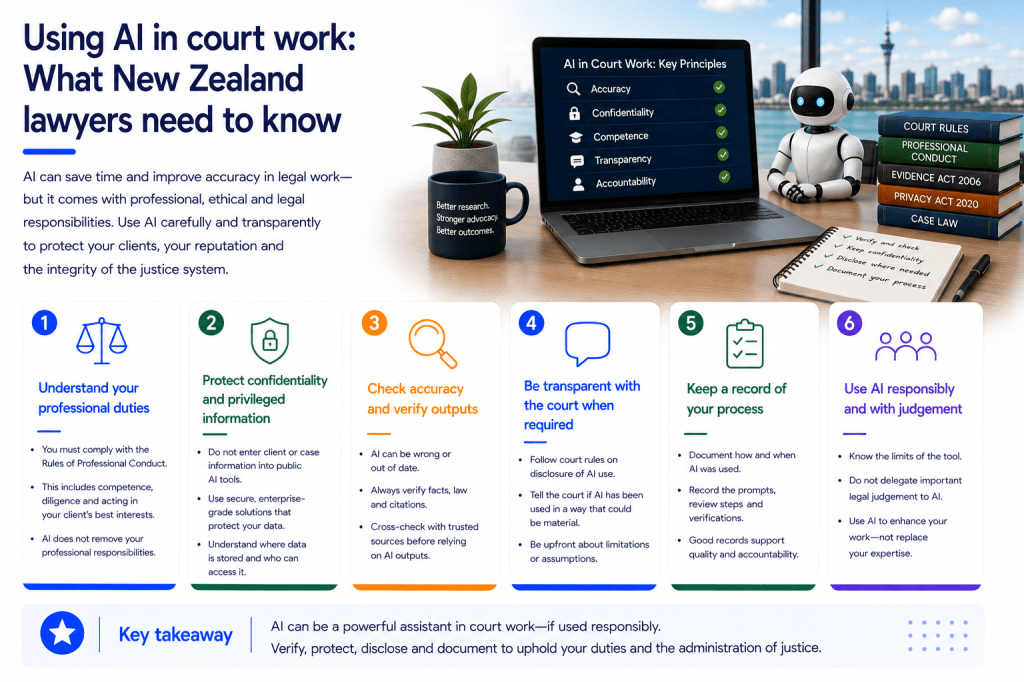
- Lawyers remain responsible for every document, citation and factual statement submitted to a court or tribunal.
- Private, confidential, privileged or suppressed information should not be entered into public AI tools.
- Lawyers do not need to disclose their use of generative AI as a matter of course, unless asked by the court or tribunal.
The Courts of New Zealand has issued separate generative AI guidance for lawyers, judicial officers and non-lawyers participating in court and tribunal proceedings.
For lawyers, the central message is clear: existing professional obligations continue to apply, regardless of whether work was drafted, researched or refined using AI. The guidance does not prohibit generative AI, but it expects lawyers to understand its limitations, protect sensitive information and independently verify everything relied upon. (Courts of New Zealand)
Professional obligations still apply
Lawyers remain subject to their duties under the Lawyers and Conveyancers Act 2006 and the Conduct and Client Care Rules.
This includes the obligation to uphold the administration of justice, avoid misleading the court and take reasonable steps to ensure that information provided to a court or tribunal is accurate.
AI does not change those responsibilities. A lawyer cannot rely on the fact that an incorrect case, quotation or legal proposition was generated by a chatbot. Any AI-assisted material must be checked by an appropriately qualified person before it is used in proceedings.
The guidance warns that generative AI may:
- invent cases, citations, quotations or legislation;
- apply overseas law that is not relevant in New Zealand;
- provide incomplete or outdated information;
- make factual errors; and
- confidently confirm that incorrect information is accurate.
This makes AI unsuitable as a replacement for trusted legal databases, authoritative sources or professional judgement.
Court information requires particular care
The guidance states that lawyers generally should not enter information into an AI chatbot unless it is already in the public domain.
That restriction is especially important in litigation and tribunal work, where material may include:
- privileged legal advice;
- confidential client information;
- evidence that is not publicly available;
- information covered by a suppression order;
- personal information about witnesses or other parties; and
- commercially sensitive documents.
Entering this material into an external AI system could create privacy, confidentiality, privilege or publication risks. Where an unintended disclosure occurs, the lawyer should take the steps normally expected following that type of disclosure, including contacting the relevant registry promptly where a suppression order may have been breached.
An internal or enterprise AI tool may offer stronger contractual and technical safeguards, but it does not remove the lawyer’s underlying obligations. Firms still need to understand what information the system retains, where it is processed and whether it may be reused.
AI can assist, but it should not lead the legal analysis
Generative AI can be useful for natural-language tasks such as:
- improving structure and readability;
- changing the tone or format of text;
- producing an initial outline;
- summarising public material; and
- identifying issues for further research.
However, the broader judicial guidance says AI is ill-suited to legal analysis because it generates text from patterns and probabilities rather than a genuine understanding of the law, facts or human reasoning. It may also reflect bias, misinformation and overseas legal concepts contained in its training material.
The guidance also notes that AI systems may not adequately account for New Zealand’s cultural context or the values and practices of Māori and Pasifika.
A safer approach is to use AI for a defined supporting task, then conduct the substantive research and analysis using reliable New Zealand legal sources.
Disclosure is not automatic
Lawyers do not need to disclose their use of generative AI as a matter of course, provided the guidance has been followed.
However, a court or tribunal may ask or require a lawyer to disclose whether AI was used. Firms should therefore be able to explain:
- what tool was used;
- what task it performed;
- what information was entered;
- how confidentiality was protected; and
- how the result was independently verified.
The judicial guidance also identifies warning signs that may prompt closer scrutiny, including unfamiliar authorities, American spelling, overseas cases and persuasive-looking submissions containing substantive errors. Courts must also consider the possibility that AI-generated images, audio or video could be presented as evidence.
What this means for your organisation
Law firms should take five practical steps:
- Set rules for court-related AI use Clearly identify approved tools, permitted tasks and information that must never be entered.
- Require verification from original sources Every case, citation, quotation, legislative reference and factual statement should be checked against an authoritative source.
- Protect sensitive information Address privilege, confidentiality, suppression, privacy and document-handling requirements within the firm’s AI policy.
- Keep an appropriate record For significant court work, record how AI was used and how the output was reviewed. This will help the firm respond if disclosure is later requested.
- Train and supervise staff Lawyers, graduates and support staff should understand that fluent AI-generated text is not evidence of accuracy.
Conclusion
The Courts of New Zealand guidance does not prevent lawyers from using generative AI. It places that use within the profession’s existing duties.
AI may help with structure, summarisation and early drafting, but lawyers remain responsible for protecting information, checking sources and ensuring that every submission made to a court or tribunal is accurate.
The practical test is not simply whether AI was used. It is whether the lawyer remained in control of the work.
Sources
- Courts of New Zealand, Guidelines for Use of Generative Artificial Intelligence in Courts and Tribunals. (Courts of New Zealand)
- Courts of New Zealand, Guidelines for Lawyers, 7 December 2023.
- Courts of New Zealand, Guidelines for Non-lawyers, 7 December 2023.
- Courts of New Zealand, Guidelines for Judges, Judicial Officers, Tribunal Members and Judicial Support Staff, 7 December 2023.
Qualification
This article provides general information about AI governance and court-related practice. It is not legal advice and does not replace the applicable legislation, professional rules, court directions or the Courts of New Zealand guidance.