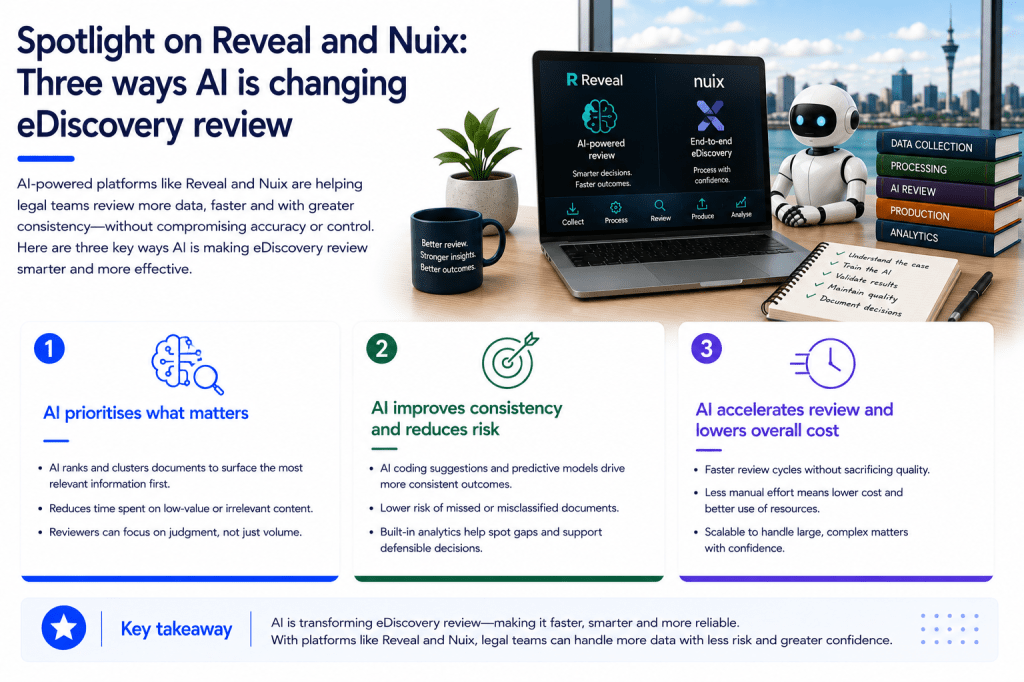
AI-assisted review is becoming a practical part of modern eDiscovery, but the term covers several different technologies.
Some systems learn from the decisions reviewers make. Others allow lawyers to question a document collection using everyday language. The latest tools can conduct an initial review themselves, with human reviewers checking, correcting and validating the results.
This article looks at the three approaches through the lens of Reveal and Nuix Discover. Other established eDiscovery platforms provide comparable functions, although the terminology, workflow and level of automation may differ.
1. Continuous Active Learning: the model learns from the reviewers
Reveal terminology: Supervised Learning and Active Learning
Nuix terminology: Predictive Coding using Continuous Active Learning, or CAL
Continuous Active Learning is the most established form of AI-assisted document review.
Reviewers begin coding documents, commonly as relevant or not relevant. The software analyses those decisions, identifies patterns and assigns predictive scores to the remaining documents. As the review continues, the model is retrained and the review queue is reordered so that documents most likely to be relevant appear earlier.
Reveal describes this through its Supervised Learning models. Reviewer decisions are used to score documents and update the model through Active Learning. Its supervised workflows can also use different methods for selecting the next documents that will be most useful for training.
Nuix Discover uses the more traditional terminology of Predictive Coding using Continuous Active Learning. The Nuix workflow automatically checks for newly reviewed documents, uses those decisions to refine the model and then reprioritises the remaining collection.
Where CAL is useful
Large relevance reviews – Where a matter contains hundreds of thousands of emails, documents and messages, CAL can bring the most promising material to the front of the queue. This allows the legal team to understand the case earlier and concentrate human effort where it is most valuable.
Rolling collections – CAL is well suited to matters where new custodians or data sources are added over time. Newly reviewed documents can continue to inform the model as the review population expands.
Privilege or confidentiality review – A separate model can be trained around privilege, confidentiality or another defined issue. It does not replace legal judgement, but it can identify likely candidates and prioritise them for closer review.
Locating potentially relevant documents – CAL can prioritise material predicted to be responsive based on the reviewers’ earlier coding decisions. Appropriate sampling and quality-control checks remain necessary to identify missed, unexpected or incorrectly classified documents.
The important point is that the model is learning from people. Consistent coding decisions, suitable training examples and experienced oversight remain critical. A model trained on unclear or inconsistent decisions may simply reproduce those problems at scale.
2. Natural-language questions: talking to the document collection
Reveal terminology: Ask
Nuix terminology: Semantic Search
The second approach allows users to interact with evidence using natural language rather than relying entirely on keywords and Boolean searches.
A lawyer might ask:
What did the project team say about the cost overruns before the board meeting?
Reveal Ask searches the project data for semantically related passages, returns a narrative response and identifies the documents and excerpts supporting that answer. Users can follow the citations into the document viewer and examine the original material in context. Ask can operate across the full document population or a defined subset. Reveal also identifies potential workflows including early investigation, locating key documents, finding training material for CAL and identifying potentially privileged information.
Nuix’s closest current equivalent is Semantic Search. It allows users to search by meaning, intent and context rather than requiring an exact keyword match. Nuix describes it as supporting natural-language searches across text, images and multimedia, including searches that cross language differences.
The two functions should not be treated as identical. Reveal Ask is designed to generate a narrative answer supported by document-level citations. Nuix Semantic Search is primarily designed to locate conceptually relevant evidence. Both reduce reliance on exact terminology, but the way results are presented and validated differs.
Where natural-language tools are useful
Early case assessment
At the beginning of a matter, the team can investigate broad questions such as:
- Who first identified the problem?
- When was senior management informed?
- Why was the transaction delayed?
- What explanations were given for the disputed payment?
The results can help identify key people, events and documents before a full review is completed.
Building a chronology – Natural-language searches can locate communications around an event, decision or date range. They can also surface different descriptions of the same event that a conventional keyword search may miss.
Testing a case theory – A legal team can explore whether the documents support or contradict a particular allegation, explanation or defence.
The question should not be framed only to confirm the preferred theory. Searches should also be designed to locate contrary explanations and adverse evidence.
Reviewing an incoming production – Natural-language exploration can help the receiving team understand a new production quickly, identify central themes and locate possible gaps requiring follow-up.
The generated answer or search result is still a route into the evidence. It should not replace reading the underlying documents, checking attachments and considering the broader context.
3. AI review: the software performs the first pass
Reveal terminology: aji GenAI Review
Nuix terminology: AI Review or AI-driven first-pass review
The third approach changes the reviewer’s role more significantly.
Instead of waiting for people to code enough documents to train a traditional model, the legal team defines the review question or criteria in plain language. The AI then assesses documents against those criteria and produces an initial relevance or issue decision.
Reveal’s aji is its generative AI review engine. It can review documents against definitions prepared by the legal team, with the results then assessed and validated through the review workflow. Reveal also offers hybrid workflows that combine generative AI review with supervised learning.
Nuix Discover calls its comparable capability AI Review. It applies preliminary coding decisions, highlights key issues and flags documents for human review. Results include relevance scores and natural-language explanations supported by citations within the document content. Nuix also describes human quality-control workflows for accepting, overriding or escalating the AI-generated decisions.
Where AI review is useful
First-pass relevance review – Where the issues can be expressed clearly, AI can conduct the initial assessment of the document population. Human reviewers can then concentrate on checking the likely relevant documents, borderline results and samples from the documents classified as not relevant.
Issue coding – Documents can be assessed against defined issues such as:
- knowledge of a particular event;
- communications about contractual performance;
- reasons for a decision;
- financial loss or damages;
- regulatory concerns; or
- discussions involving particular individuals or teams.
Privilege and confidentiality – AI review can flag documents that may contain legal advice, confidential information or personal data. The final decision should remain with an appropriately qualified reviewer.
Urgent investigations – In a regulatory response, workplace investigation or time-sensitive dispute, AI review can rapidly identify likely important documents for priority human assessment.
Quality control – AI review can also be used as a second perspective. The team can compare its conclusions with the decisions made during a manual or CAL-assisted review and investigate areas of disagreement.
The quality of the written review criteria matters. A vague instruction such as “find important documents” provides little basis for a consistent assessment. Better definitions explain the relevant conduct, people, period, exceptions and examples. The criteria should be tested against representative documents before being applied at scale.
Security must be part of the review design
eDiscovery collections routinely contain privileged advice, personal information, commercially sensitive material and evidence subject to legal restrictions. AI functionality should therefore be assessed within the security controls of the review platform, rather than used through an uncontrolled public AI tool.
Reveal describes controls including encryption, regional data hosting, user and team permissions, activity logging and flexible deployment options. Its permissions framework also allows access to generative AI functions such as Ask and aji to be restricted to authorised roles.
Nuix Discover supports cloud, on-premises and hybrid deployment. Nuix states that the platform holds ISO 27001 and SOC 2 certifications, while its current environment includes options such as single sign-on and role-based security. AI Review is also available on-premises for organisations requiring greater control over data location and infrastructure.
Selecting the right method
The three approaches solve different problems.
Use Continuous Active Learning where reviewers will be making the primary decisions and the immediate goal is to prioritise the documents most likely to be relevant.
Use natural-language tools where the team needs to explore the evidence, locate concepts expressed in different language or understand the likely narrative within the data.
Use AI Review where the review criteria can be defined clearly and the team wants the software to conduct an initial assessment before human quality control.
Many matters will use more than one. A team might begin with Ask or Semantic Search to understand the issues, use AI Review for an initial classification, and apply CAL as human decisions accumulate.
How we can help
Incident Response Solutions provides forensic collection, Nuix processing, cloud-hosted review, Technology Assisted Review and support through its Forensic Tech service. Its available review solutions include both Reveal and Nuix Discover, alongside other established platforms. (Forensic Tech)
This allows the review method to be selected around the matter rather than forcing every project into the same workflow.
Forensic Tech can assist with:
- collecting and processing the source material to a forensic standard;
- selecting and configuring the review platform;
- developing CAL training and validation workflows;
- designing natural-language questions and searches;
- preparing definitions for AI first-pass review;
- establishing human review and quality-control procedures;
- configuring access and security controls; and
- documenting the process where transparency or expert evidence may be required.
The objective is not to remove lawyers from review. It is to use the right technology so their time is focused on the documents and decisions that genuinely require legal judgement.
Conclusion
AI-assisted eDiscovery has moved beyond a single predictive-coding workflow.
Continuous Active Learning learns from reviewer decisions and continually improves document prioritisation. Natural-language tools allow legal teams to investigate evidence without predicting every possible keyword. AI Review can conduct an initial classification, leaving people to test the results and make the final decisions.
Reveal and Nuix Discover provide useful examples of all three approaches. The strongest workflow will depend on the data, issues, deadline, security requirements and level of human validation needed.
Sources