Key takeaways
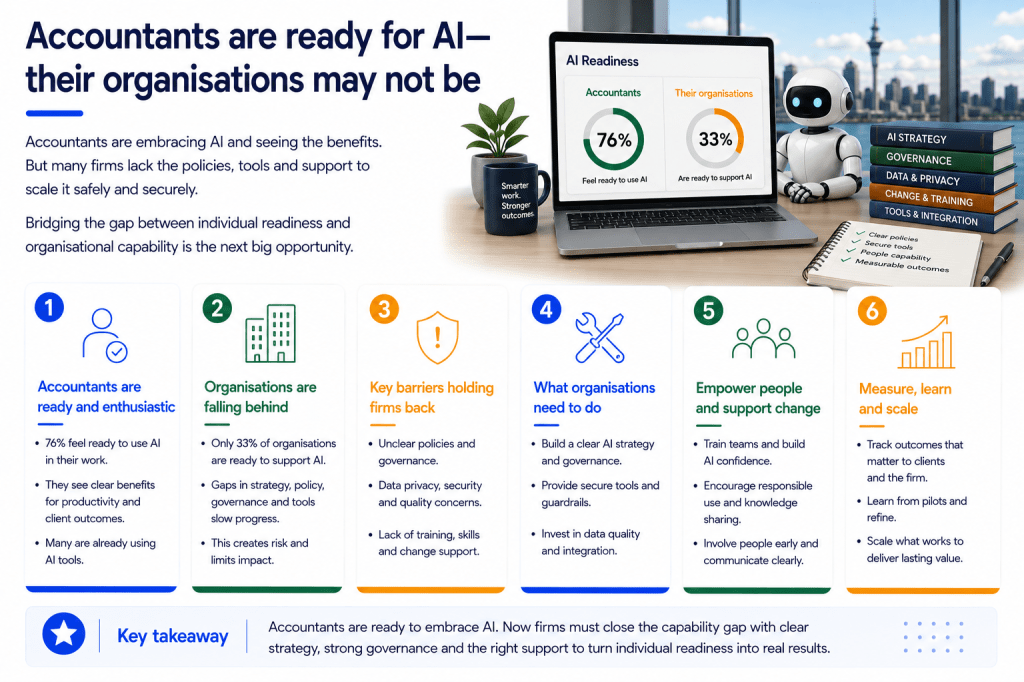
- Chartered accountants are willing to use AI, but many organisations have not provided the tools, training or governance needed to support them.
- Adoption is still largely driven by individuals using general-purpose AI for productivity rather than coordinated business transformation.
- The profession’s opportunity is not simply to automate accounting work, but to strengthen its role in strategic advice, assurance and data governance.
Artificial intelligence is already changing accounting, but the change is uneven.
Research commissioned by Chartered Accountants Worldwide and conducted by Ipsos UK found that 85 percent of surveyed chartered accountants were at least fairly willing to use AI. At the same time, many felt unprepared, lacked suitable training or remained concerned about data security.
The study drew on 2,718 survey responses from members of 13 professional institutes, including 284 respondents in New Zealand. It also included six interviews with people involved in implementing AI.
The findings point to a clear gap. Accountants are interested in AI, but organisational support has not always kept pace.
Willingness is not the problem
Interest in AI was strong across the profession.
Overall, 85 percent of respondents said they were very or fairly willing to use AI. Willingness was particularly high among younger professionals and people working in larger organisations.
Most respondents also recognised that AI will significantly affect accounting work, training and career development. However, they generally saw it as a tool that would augment accountants rather than replace them.
Fifty-two percent disagreed that the value accountants provide could be replaced by automated systems. The research instead emphasises the continuing importance of professional judgement, contextual understanding and critical thinking.
AI may generate a forecast, identify an anomaly or draft financial commentary. An accountant must still decide whether the result is reliable, relevant and appropriate for the decision being made.
Adoption is being driven from the bottom up
Much of the current adoption appears informal.
Employees and individual teams are experimenting with AI to improve their own productivity, rather than using systems introduced through an organisation-wide programme.
Among frequent users, the main reasons for adoption included excitement about AI and a tendency to adopt new technology early. Only 21 percent identified good access to organisational AI tools as a main reason for frequent use.
The report also found that 70 percent of respondents using AI at least monthly were using publicly available generative AI chatbots such as ChatGPT or Gemini. Use of internal systems and specialised machine-learning tools was much lower.
Common applications included:
- general productivity;
- data entry;
- account reconciliation;
- financial reporting;
- budgeting and forecasting;
- knowledge management.
This suggests many firms are still using AI as a personal assistant rather than redesigning complete accounting, audit or advisory processes.
The immediate governance challenge is not whether employees will use AI. It is whether organisations can make that use visible, safe and consistent.
Employee-led experimentation can reveal valuable use cases quickly. But it can also create inconsistent practices, particularly when staff use different tools, enter information under different assumptions and apply different levels of review.
Security and skills remain the main barriers
Among respondents who did not use AI frequently, 30 percent identified data security as a main concern. Twenty-six percent said they lacked the necessary skills because of insufficient training, while the same proportion said available tools did not adequately meet their job needs.
At a profession-wide level, 52 percent identified insufficient skills and training as a leading barrier to adoption. Security, resistance to change and ethical concerns also ranked highly.
These issues are connected.
Employees may avoid approved systems because they do not understand how information is processed. Others may use public tools without appreciating whether client or organisational data could be retained or reused.
Senior professionals were particularly cautious. The research found that 53 percent of executive and C-suite respondents did not feel prepared for AI’s impact over the following five years. Security concerns were also more prominent among senior decision-makers.
The qualitative interviews identified three common approaches:
- using AI features added to established platforms;
- applying formal internal review and approval processes;
- avoiding adoption because of security and regulatory uncertainty.
One organisation described an internal AI forum that reviewed proposed tools through a documented approval process. Another relied on Microsoft Copilot because it operated within an existing Microsoft environment.
These examples show that governance does not have to prevent adoption. It can create the confidence needed to permit it.
Training must be practical
Only 30 percent of respondents had participated in AI training offered through their organisation. Among those who had not, 61 percent said their organisation did not provide it.
Yet 92 percent said they would be very or fairly likely to participate in future employer-provided training.
Respondents also expected professional bodies to play a significant role. Sixty-five percent expected professional accountancy bodies to provide AI training, compared with 32 percent who expected their employer to do so.
This expectation was especially strong among people working in smaller organisations, which may not have the resources to create their own programmes.
The requested training was not limited to using chatbots. Respondents prioritised:
- critical thinking;
- privacy and data security;
- client relationship skills;
- AI ethics;
- advisory capability;
- digital literacy;
- AI governance.
Critical thinking ranked above digital literacy and data-science skills.
Effective training should therefore cover more than prompts and software features. Accountants need to understand what information may be entered into a system, how outputs should be checked, when human review is required and who remains responsible for the final result.
Training should also reflect different roles. A junior accountant drafting a client email, a tax specialist researching an issue and a finance director reviewing an automated forecast face different risks.
Accountants can become stronger data guardians
One of the report’s most important findings concerns the future role of accountants as “Data Guardians”.
Seventy-nine percent of respondents agreed that, as AI becomes more integrated into business, accountants’ responsibility for data governance will become increasingly important.
AI systems depend on data to generate predictions, recommendations and content. Poor-quality or improperly governed data can produce misleading results at greater speed and scale than a manual process.
Accountants are well placed to ask:
- Where did the data come from?
- Is it complete and accurate?
- Was it collected and used appropriately?
- Who can access or change it?
- Can the organisation explain how the output was produced?
- Is there an adequate audit trail?
- Who reviewed the result?
These are familiar questions for a profession built around evidence, assurance and accountability.
The report also found that:
- 87 percent believed AI would allow accountants to focus more on strategic advice;
- 85 percent thought AI proficiency would become important for career progression;
- 83 percent believed firms that failed to integrate AI would struggle to compete.
The opportunity is therefore broader than efficiency. AI may allow accountants to spend less time assembling information and more time interpreting it, advising leaders and testing whether decisions are supported by reliable evidence.
What this means for your organisation
1. Identify current AI use
Survey employees and review existing software to identify public tools, embedded AI features and informal workflows.
An organisation cannot govern activity it does not know is happening.
2. Provide a safe route to experimentation
Create a controlled environment where staff can test AI using fictional, synthetic or demonstrably non-sensitive information. Do not use client or personal information unless the tool and proposed use have been approved and the organisation has confirmed that its privacy, confidentiality and security requirements are met.
A complete prohibition may encourage hidden use. Supported experimentation makes it easier to identify useful applications and address risk early.
3. Introduce role-based training
Provide a common foundation covering confidentiality, verification, security and responsible use, followed by training tailored to audit, tax, advisory and finance roles.
4. Integrate AI into trusted systems
Fifty-one percent of respondents said they would use AI more if it were better integrated into existing tools.
Where appropriate, organisations should examine AI capabilities within platforms employees already understand rather than introducing disconnected tools without established security controls.
5. Include accountants in AI governance
Finance and accounting professionals should be involved in procurement, risk assessment, data governance, testing and monitoring.
Their role should begin before a system is purchased, not after implementation.
Conclusion
The Chartered Accountants Worldwide research does not describe a profession resisting AI. It describes a profession that is interested, experimenting and broadly optimistic, but often operating without sufficient organisational direction.
Accounting firms and finance teams need to provide secure tools, practical training and clear governance while preserving the human judgement on which clients and organisations rely.
Those that do this well will not simply automate existing tasks. They will strengthen the accountant’s role as a strategic adviser, trusted professional and guardian of the information on which increasingly automated businesses depend.
Sources
The survey used an open link distributed through participating institutes and did not apply quotas. Its percentages are indicative of respondents rather than representative of the accounting profession as a whole. Although 284 New Zealand-based participants completed the survey, the published headline findings are global.