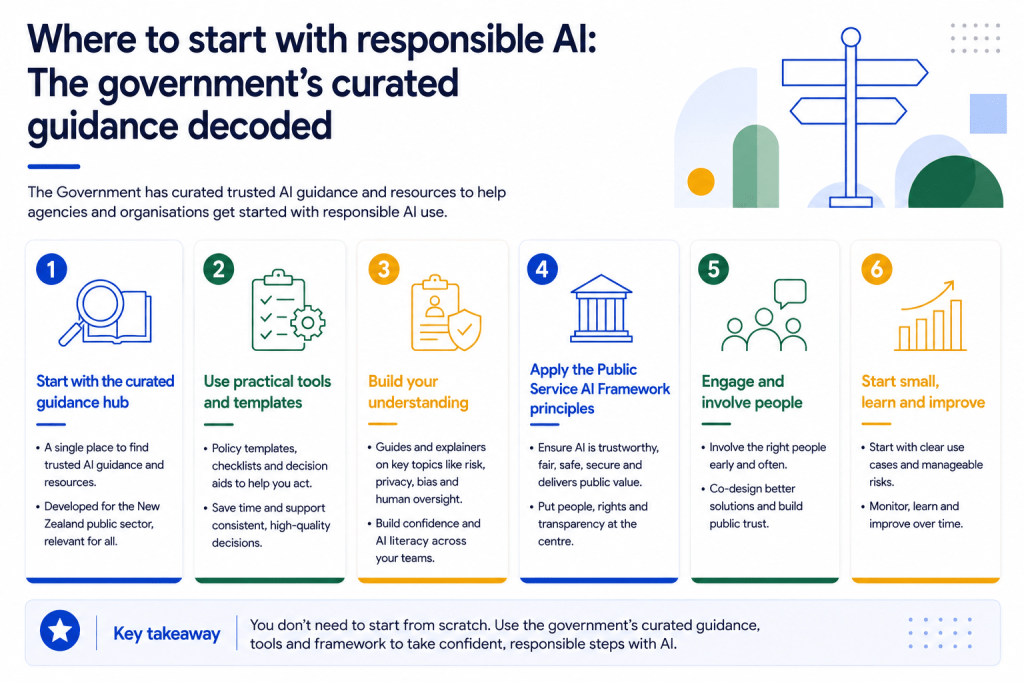
Key Takeaway: New Zealand’s Centre for Data Ethics and Innovation has published a shortlist of AI guidance it considers worth your attention – spanning public service GenAI rules, Privacy Commissioner expectations, governance toolkits, international principles, and a practical procurement questionnaire. For organisations wondering which of the hundreds of AI frameworks out there actually matter in a New Zealand context, this page is effectively the official answer. The most immediately actionable piece is its three-stage ethics checklist for procuring AI: before, during, and after you buy.
Why this page matters
One of the quiet problems of the AI boom is guidance overload. Every regulator, industry body, and standards organisation on the planet has published an AI framework, and for a busy New Zealand organisation it’s genuinely hard to know which ones carry weight here.
The Centre for Data Ethics and Innovation – part of the Government Chief Data Steward’s leadership function, hosted on data.govt.nz – has done the filtering. Its Artificial Intelligence Guidance page is a curated set of resources the Centre considers good starting points for any AI project. It sits alongside the Centre’s other ethics tools, including the Privacy, Human Rights and Ethics (PHRaE) Framework, Ngā Tikanga Paihere, and dedicated guidance on Māori data and AI for business.
While the Centre’s remit is government data ethics, almost everything on the list applies just as readily to the private sector. Here’s what’s on it, and what each piece is actually for.
The shortlist, decoded
Responsible AI Guidance for the Public Service: GenAI. Published on digital.govt.nz, this is the rulebook for how the New Zealand Public Service explores generative AI safely, transparently, and responsibly – an update and expansion of the interim guidance first issued in July 2023. If you sell into government, this document describes the standards your public sector customers are being held to. If you don’t, it’s still one of the clearest locally-written treatments of GenAI risk available.
The Privacy Commissioner’s AI guidance. The Office of the Privacy Commissioner has set out how the information privacy principles in the Privacy Act apply to AI. This is the piece with real teeth: it isn’t aspirational best practice, it’s the regulator explaining how existing law applies to your AI use. If you read only one item on the list, make it this one.
AI Governance (aigovernance.nz). Developed by the AI Forum, this website offers resources for inclusive and responsible AI adoption, including guidance on working with Māori data and practical toolkits. It’s the most hands-on resource on the list – closer to “how do we actually set this up?” than “what should we believe?”
The OECD Principles for Trustworthy AI. These value-based principles – covering transparency, fairness, accountability, and human oversight – are the international framework New Zealand has formally anchored its national AI Strategy to. They come with examples of the principles in practice, and they’re the common language you’ll see echoed through everything else on this list.
The International Science Council’s guide for policy-makers. Released in April 2024 under the leadership of Sir Professor Peter Gluckman, this guide helps decision-makers evaluate rapidly developing technologies, including large language models. Usefully, it ships with a fill-in framework (a structured spreadsheet of evaluation questions) you can work through when assessing an LLM – a rare example of an evaluation tool you can actually put in front of a project team.
The standout: ethics across the AI procurement lifecycle
The most practical element of the page is its guidance on procuring AI, anchored by the Algorithm Impact Assessment Questionnaire. The Centre’s framing is that ethical questions don’t arrive at a single point in a procurement – they run through three distinct stages:
- Pre-procurement: Is AI actually the right solution? Would a proven, conventional technology solve your problem just as well? This is the question most organisations skip in the excitement, and it’s the cheapest point at which to get the answer right.
- During procurement: Do you understand the training data behind the system you’re buying? Who owns it? And critically for us – does that data fit the New Zealand context? A model trained overseas may perform very differently on New Zealand names, te reo Māori, local geography, or our regulatory environment.
- Post-procurement: The work doesn’t end at go-live. Systems need ongoing monitoring and testing to catch model drift and emerging bias. An AI that was fair and accurate at deployment won’t necessarily stay that way.
That three-stage lens is worth adopting whether or not you’re in government, and whether you’re buying AI or building it.
What this means for your organisation
- Use this page as your reading list. Rather than trying to survey the global AI framework landscape yourself, treat the Centre’s curation as the New Zealand-relevant core. Between this list and MBIE’s Responsible AI Guidance for Businesses, you have the local canon.
- Prioritise the Privacy Commissioner’s guidance. It’s the item on the list backed by existing law. Map your current and planned AI use against the information privacy principles first.
- Steal the procurement lifecycle. Build the pre/during/post ethics questions into your standard procurement and project processes now. The Algorithm Impact Assessment Questionnaire gives you a ready-made template to adapt.
- Ask the “New Zealand context” question of every vendor. Whose data trained this system, who owns it, and does it reflect our population and environment? It’s a simple question that surfaces a remarkable amount.
- Don’t overlook the Māori data resources. Both the AI Forum’s governance site and the Centre’s companion guidance on Māori data and AI for business address considerations that are increasingly expected of responsible organisations here – and that generic international frameworks won’t cover.
The pattern across New Zealand’s approach to AI is consistent: no new rules, but clear expectations, expressed through existing law and curated guidance. Pages like this one are how the Government tells you what “responsible” looks like. Reading them is the easy part – building them into how your organisation actually buys, builds, and monitors AI is where the value is.
The full guidance list is available on data.govt.nz: Artificial Intelligence Guidance – Centre for Data Ethics and Innovation.
This article is general information, not legal or professional advice. Talk to us about putting responsible AI guidance into practice in your organisation.
Related reading
- AI governance and accountability in New Zealand
- What NZ’s first AI Strategy means for business
- Free AI governance templates and resources