Key takeaways
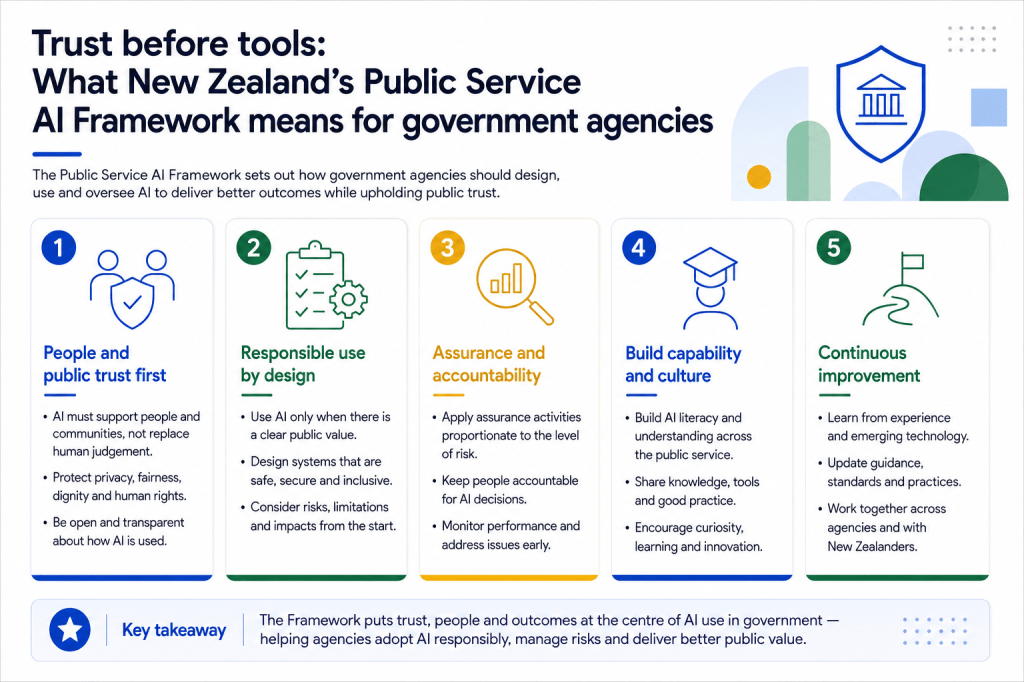
- New Zealand’s Public Service AI Framework is outcomes-focused and built on five OECD-aligned principles.
- It takes a deliberately light-touch, trust-first approach rather than heavy regulation.
- Agencies should build trust and capability before rushing to adopt AI tools.
New Zealand has set out its stall on artificial intelligence in government. The Public Service AI Framework – published by the Government Chief Digital Officer (GCDO), whose functions have since been integrated into the new Government Digital Delivery Agency (GDDA) under the Public Service Commission – sits within the National AI Strategy launched in July 2025. It is less a rulebook than a compass, and that distinction matters for every agency now weighing up how, where and whether to deploy AI. A year on, events have tested that compass in ways worth examining.
A vision anchored in outcomes, not technology
The Framework’s vision is deliberately plain: adopt AI responsibly to modernise public services and deliver better outcomes for all New Zealanders. Notice what it doesn’t say. There is no mandate to adopt AI at pace, no efficiency target, no technology shopping list. Instead, the emphasis falls on responsibility, human-centricity and public trust – with citizens, taxpayers and public service workers positioned at the forefront of design and implementation.
The intended outcome goes a step further: the Public Service should model best practice in AI use, contributing to the wider community and economy in a way that reinforces New Zealand’s standing as a trusted global partner. In other words, government is meant to lead by example, not simply keep up.
Five principles with an OECD pedigree
Rather than inventing a bespoke ethics framework, New Zealand has adopted the OECD’s values-based AI principles – inclusive and sustainable development, human-centred values, transparency and explainability, safety and security, and accountability. Cabinet agreed in June 2024 to promote the OECD principles as the cornerstone of New Zealand’s approach to responsible AI.
This is a pragmatic choice. Aligning with the OECD gives agencies a common vocabulary with international counterparts and avoids the fragmentation that plagues jurisdictions with home-grown frameworks. The principles are also cross-referenced against the UK’s Generative AI Framework, the Algorithm Charter for Aotearoa New Zealand, and the AI Forum NZ’s Trustworthy AI principles – so agencies already working with those instruments will find familiar ground.
Regulation: light-touch by design
Perhaps the most consequential signal in the Framework is what New Zealand has decided not to do. Cabinet has agreed to a light-touch, proportionate and risk-based approach to AI regulation. There will be no standalone AI Act in the near term. Further regulatory intervention will only be considered where it unlocks innovation or addresses acute risks, and existing legal mechanisms will be preferred over new ones.
That doesn’t mean a regulatory vacuum. The Framework points agencies to the existing web of law and convention that already governs public sector AI use – including the Treaty of Waitangi, the Privacy Act 2020, the Official Information Act 1982, the Bill of Rights Act 1990, the Human Rights Act 1993, the Copyright Act 1994, the Public Records Act 2005 and the Public Service Act 2020. The message to agencies is clear: the guardrails largely exist already, and the obligation is to apply them thoughtfully to a new class of technology.
For practitioners, this places a heavier burden on internal governance. Without a prescriptive AI statute, agencies must interpret how established obligations – privacy, official information, records management, human rights – translate into AI procurement, deployment and monitoring decisions.
Four focus areas of the AI work programme
Implementation has moved from abstract pillars to a concrete, two-year Public Service AI Work Programme structured around four focus areas. Common use tools delivers shared infrastructure – a centralised Public Service AI Hub, an AI Sandbox for safe trialling, and an AI Accelerator Lab. Safe and responsible AI introduces a standardised assurance model and toolkit, alongside safety and security certifications. Customer and partnerships puts vendor engagement on a systematic footing rather than leaving each agency to negotiate alone. AI workforce elevates AI skills and literacy across the public sector.
The shift is telling. The Framework’s original six conceptual pillars – governance, guardrails, capability, innovation, social licence and global voice – have been refocused into action areas designed to drive faster, safer uptake. This moves the strategy from high-level ethics into practical, repeatable public service infrastructure: less about what agencies should believe, more about what they can actually reuse.
What agencies should actually do with it
The Framework is not binding – agencies are encouraged, not compelled, to align with it. But it offers four practical entry points. Agencies can use it to guide AI development by checking initiatives against the principles at design stage; to inform policy formulation, shaping organisational AI governance and guardrails; to build skills, embedding the principles into staff training; and to evaluate AI initiatives against its values and rules.
For leaders, the sensible first move is a gap analysis: map current and planned AI use against the five principles and the existing legislative context, and identify where governance, capability or transparency falls short.
The bottom line: the risk that materialised
The Framework’s absence of hard mandates was always both its strength and its risk – agencies had flexibility, but flexibility without disciplined internal governance drifts into inconsistency. In July 2026, that risk stopped being hypothetical. Public Service Commissioner Sir Brian Roche released the findings of a scathing rapid review into government digital delivery, which found digital investment across government fragmented, duplicative and poorly coordinated, with the centre exercising limited influence over key funding, design and procurement decisions. On the AI front specifically, 70 agencies had identified 272 AI use cases – but only around 20% were actually deployed or operational, with widespread tool duplication and fragmented usage across the system.
The consequence is a decisive change in posture. The government is moving away from flexible agency-by-agency decisions toward a defined Digital Government Target State, with the GDDA and Treasury now mandated to stop agencies building bespoke, siloed AI tools where shared, centralised platforms can be reused instead. The shift of the GCDO’s functions into the GDDA was made explicitly to break down agency silos and enforce an “invest once, reuse many times” model.
New Zealand’s Public Service AI Framework still reflects a distinct national posture: enable innovation, lean on existing law, invest in trust, and let government model the behaviour it wants to see across the economy. But the era of treating it as optional guidance is closing. The agencies that thrive under the reset will be those that treated the Framework as a floor rather than a ceiling all along – and that are now positioned to plug into shared platforms rather than defend bespoke ones.
Sources: Public Service AI Framework, digital.govt.nz; Public Service Commission rapid review of digital delivery (July 2026).
Related reading
- What the Public Service AI Toolkit means for agencies
- Where to start with responsible AI
- Our AI governance and advisory services