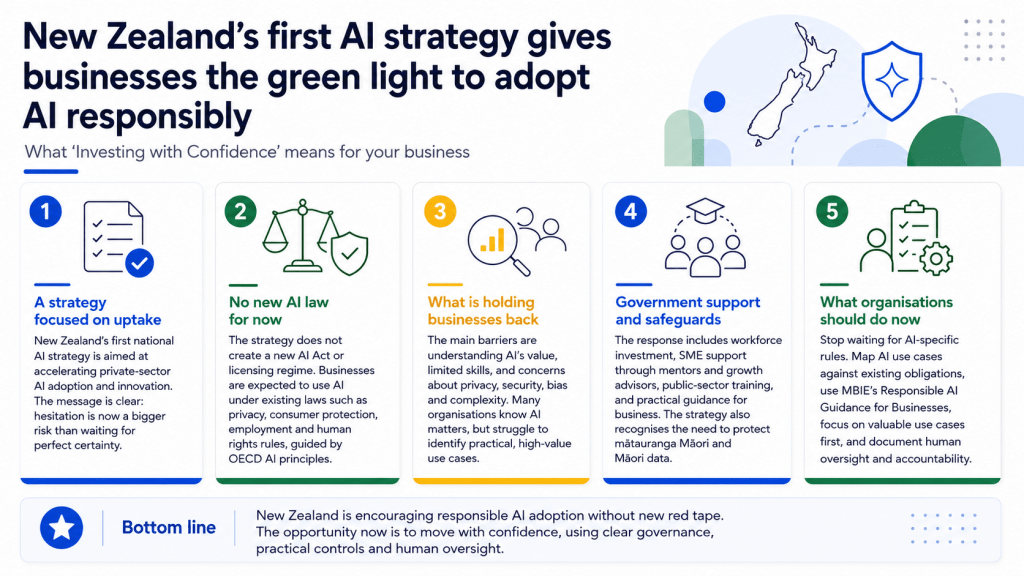
Key Takeaway: New Zealand now has a national AI strategy focused on encouraging responsible adoption. The Government is currently relying on existing technology-neutral laws and a light-touch, principles-based approach, while identifying practical barriers that businesses can act on today.
A strategy focused on uptake, not red tape
The Ministry of Business, Innovation and Employment (MBIE) has published New Zealand’s Strategy for Artificial Intelligence: Investing with confidence, the country’s first national AI strategy. Its subtitle – Accelerating Private Sector AI Adoption and Innovation – tells you most of what you need to know about its intent.
Unlike jurisdictions racing to build frontier AI models or comprehensive AI legislation, New Zealand has made a deliberate choice: this strategy is about adoption and application, not foundational AI development. The Government’s view is that for an economy of our size, the greatest gains come from businesses actually using AI well – lifting productivity, competitiveness, and our ability to attract global talent and investment.
That framing matters. It signals that the Government sees hesitation, not recklessness, as the bigger economic risk for New Zealand right now.
No new AI law – and that’s deliberate
Perhaps the most consequential element of the strategy for business leaders is what it doesn’t do. The strategy does not introduce a new AI Act, licensing regime or AI-specific compliance framework. Instead, the Government is currently relying on existing technology-neutral laws and a light-touch, principles-based approach.
The strategy’s position is that our existing regulatory frameworks – privacy, consumer protection, human rights – are already largely principles-based and technology-neutral, and can be updated if and when genuinely new risks emerge. New Zealand has also anchored itself to the OECD AI Principles, the international framework for responsible AI agreed by more than 40 countries, covering values like transparency, fairness, accountability, and human oversight.
For businesses, this cuts both ways. The good news: regulatory uncertainty is not a legitimate reason to sit on your hands. The flip side: the absence of prescriptive AI rules means the responsibility for using AI safely and lawfully sits squarely with you, under laws that already apply – the Privacy Act, the Fair Trading Act, employment law, and the rest.
To help with exactly that, MBIE has released a companion document, the Responsible AI Guidance for Businesses – a voluntary, practical resource covering cybersecurity, privacy, and intellectual property considerations for organisations of any size, from sole traders up.
The barriers holding Kiwi businesses back
The strategy is refreshingly honest about why AI adoption in New Zealand lags where it could be. Drawing on local research and consultation, it identifies a set of interconnected barriers:
Understanding and perceived value. One survey cited in the strategy found that while 97% of workers had heard of AI, only around a third could clearly explain what it is. The gap is most pronounced among SMEs, where decision-makers often grasp AI in the abstract but struggle to see specific, high-value applications for their own operations – or to build confidence in the return on investment.
Skills. The 2024 Datacom State of AI Index found 43% of non-users pointed to a lack of expertise as their main reason for holding back. The strategy notes this gap runs through every layer of an organisation: technical specialists, managers integrating AI into processes, executives setting strategy, and frontline staff using the tools day to day. New Zealand’s small talent pool and global competition for AI skills intensify the problem.
Perceived complexity, ethics, and risk. Many businesses worry about privacy, security, bias, and maintaining human oversight of important decisions – particularly those handling sensitive customer information. These are legitimate concerns, and the strategy’s answer is guidance and capability-building rather than prohibition.
What the Government is doing about it
Alongside publishing the strategy itself (partly to raise awareness and spur experimentation), the Government has committed to a coordinated response:
- Workforce investment. The strategy points to Budget 2025’s broader education spend – $213 million for tuition and training subsidies, $64 million for STEM and priority areas, and $111 million to support enrolments and youth pathways into higher-level study. These are sector-wide investments rather than a dedicated AI fund, but the strategy leverages them to feed the pipeline of AI-capable graduates from programmes like Victoria University’s Master of AI.
- SME support. MBIE is upskilling Business Mentors New Zealand and Regional Business Partner Network Growth Advisors – who together support over 5,000 businesses a year – to help firms get AI-ready.
- Government leading by example. The public service is running AI masterclasses for leaders and foundational training for public servants. Notably, MBIE disclosed that officials used AI in researching and drafting the strategy itself – with human oversight throughout – as a demonstration of practical, transparent use.
- Protecting what matters. The strategy acknowledges genuine tensions, including the risk of mātauranga Māori and Māori data being used to train international AI models without consent. It frames the protection of these taonga as a shared challenge, with the Government and Māori partners exploring safeguards against misappropriation and loss of data sovereignty as international norms on AI and intellectual property take shape.
What this means for your organisation
If you’ve been waiting for a regulatory green light, this is it. Here’s where we’d suggest starting:
- Do not wait for a dedicated AI law before acting. Existing obligations covering privacy, consumer protection, employment and other areas already apply, and organisations should map their AI use against them.
- Read the Responsible AI Guidance for Businesses. It’s free, voluntary, and written for New Zealand organisations. Use it as the baseline for an internal AI policy if you don’t have one.
- Close the value gap before the skills gap. The strategy’s evidence suggests the biggest blocker isn’t technology – it’s knowing which specific applications will pay off for your business. Start with a structured discovery of use cases, then train against those, rather than pursuing generic “AI literacy” in a vacuum.
- Put human oversight in writing. The OECD principles New Zealand has adopted emphasise transparency, accountability, and human control of critical decisions. Building these into your processes now is cheap; retrofitting them later is not.
- Use the support that exists. If you’re an SME, the Regional Business Partner Network and Business Mentors New Zealand are being resourced specifically to help businesses like yours prepare for AI.
New Zealand has chosen confidence over caution. The strategy’s core bet is that Kiwi businesses, given clarity and support rather than new rules, will do the rest. The opportunity – and the responsibility – now sits with us.
The full strategy, the one-page summary, and the Responsible AI Guidance for Businesses are available on MBIE’s website: New Zealand’s AI Strategy: Investing with confidence.
This article is general information, not legal or professional advice. Talk to us about what responsible AI adoption looks like for your organisation.
Related reading
- Where to start with responsible AI
- What NZ’s Public Service AI Framework means
- Our AI governance and advisory services