Key takeaways
- New Zealand’s GCDO Public Service AI Toolkit turns responsible-AI principles into practical, usable resources.
- It gives government agencies concrete guidance for adopting AI safely and consistently.
- Agencies should start using it now to align their AI use with the wider framework.
An insights article on the GCDO’s Public Service AI Toolkit – digital.govt.nz
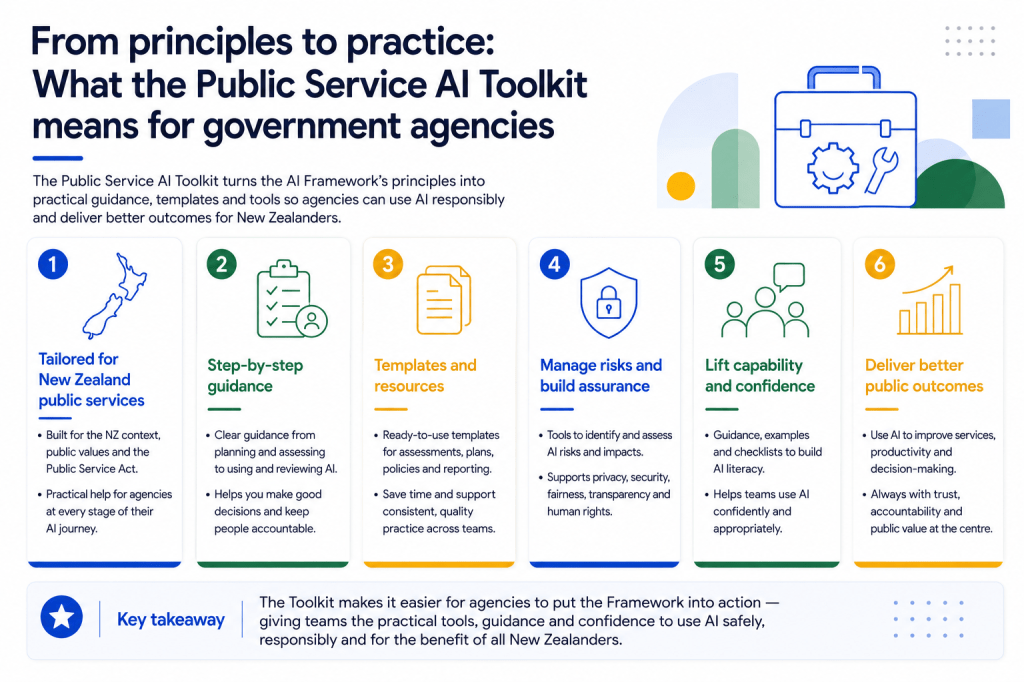
New Zealand’s public service has spent the past two years building the scaffolding for responsible AI adoption: a Public Service AI Framework (released in February 2025, and now sitting within the National AI Strategy launched in July 2025), responsible GenAI guidance, and an active AI work programme led by the Government Chief Digital Officer (GCDO). The Public Service AI Toolkit is the next logical step – a shift from telling agencies why responsible AI matters to giving them practical instruments for how to do it.
What the Toolkit is
The Toolkit is a growing collection of standardised, public service-focused resources designed to support agencies at every stage of their AI journey – from early exploration and investment decisions through to designing, implementing and assuring AI-enabled services. Its stated aim is to help agencies plan, govern and deliver AI initiatives confidently and consistently, in a way that promotes transparency, accountability and public trust.
Two things stand out about its positioning:
- Explicitly non-mandatory. The GCDO frames it as good practice rather than compliance. Agencies choose the tools that fit their context, but using them helps demonstrate alignment with government expectations for trusted and transparent AI use.
- A living resource. AI is moving fast, and the Toolkit is openly designed to grow and change with it.
What’s in it today
The Toolkit currently contains two core resources, with more signalled to come.
1. A Use of Artificial Intelligence policy template. This is arguably the most immediately useful item for most agencies. Rather than each organisation drafting an AI policy from a blank page, the template offers a starting point built on practice from mature New Zealand agencies and their international counterparts. It sets out the approach, principles and responsibilities needed for safe workplace AI use, and is designed to be read alongside the Public Service AI Framework and the Responsible AI Guidance for GenAI. The template has already been refreshed since its initial release – the current download file is labelled as an April 2026 version, while the page itself records an update in April 2025 – a sign the GCDO intends to maintain it rather than treat it as a one-off publication.
2. Records management guidance for AI. This is the quieter but arguably more consequential inclusion. The guidance makes a simple point with significant implications: AI does not change what counts as a public record. Whether a document was drafted by a person or a generative AI tool, the obligations under the Public Records Act 2005 still apply – records must be assessed on their function, purpose and value, not the technology that produced them. The guidance points agencies to Archives New Zealand for authoritative advice on retention and disposal, and works through four practical scenarios:
- Scenario 1: AI summarisation tools used for meeting notes and minutes.
- Scenario 2: Chatbots handling enquiries from the public.
- Scenario 3: AI tools used in pilot or experimental settings.
- Scenario 4: Generative AI used to draft documents or advice.
Why this matters
It lowers the barrier to responsible adoption. Many agencies – particularly smaller ones without dedicated AI governance capability – have been caught between enthusiasm for AI’s productivity potential and uncertainty about how to govern it. A ready-made policy template and worked recordkeeping scenarios remove much of that friction. The message is that agencies don’t need to start from scratch, and they don’t need to wait.
It signals maturity in New Zealand’s approach. The Toolkit sits within a coherent stack: the National AI Strategy sets the country’s overall direction, the Public Service AI Framework sets direction for government, the GenAI guidance sets behavioural expectations, and the Toolkit now supplies operational instruments. This layered approach mirrors what leading jurisdictions are doing.
The recordkeeping angle is a wake-up call. Of the two resources, the records guidance is the one most likely to expose gaps in current practice. Agencies experimenting with AI meeting summarisers, chatbots or drafting assistants may not have considered that outputs from these tools – including those produced in pilots and trials – can constitute public records. The explicit inclusion of experimental settings as a scenario is telling: informal experimentation does not sit outside the Public Records Act.
The reality check: While the Toolkit is voluntary, agencies that ignore it will find it hard to demonstrate alignment with government expectations when questions inevitably arise – whether from ministers, audit processes, the Ombudsman, or the public. In practice, “not mandatory” functions as “expected.”
What agencies should do now
Agencies looking to act on the Toolkit have a clear path forward:
- Benchmark or adopt. Assess any existing AI policy against the GCDO template, or adopt the template as a foundation if no policy exists yet – ensuring it is read alongside the Public Service AI Framework and the Responsible AI Guidance for GenAI.
- Audit the outputs. Review how AI-generated outputs are currently being captured, stored and managed – paying particular attention to informal pilots and trials – and engage Archives New Zealand early where retention or disposal questions arise.
- Maintain an active watch. Treat this as an ongoing watch area: the Toolkit will expand, and the GCDO has invited questions and feedback directly (gcdo@gdda.govt.nz).
The bottom line
The Public Service AI Toolkit is modest in size but meaningful in intent. It marks the point where New Zealand’s public service AI guidance moves from principles to practice – and it puts two clear expectations in front of every agency: have a fit-for-purpose AI policy, and treat AI-generated information with the same recordkeeping discipline as everything else. For agencies still on the fence about formalising their AI governance, the excuse of “waiting for guidance” no longer holds.
Source: Public Service AI Toolkit, digital.govt.nz (Government Chief Digital Officer). Policy template page last updated 28 April 2025 per site metadata; current template download file labelled April 2026.
Related reading
- What NZ’s public service AI policy template signals
- What NZ’s Public Service AI Framework means
- Free AI governance templates and resources